

Genuine Curiosity
Author Dwayne Melancon is always on the lookout for new things to learn. An ecclectic collection of postings on personal productivity, travel, good books, gadgets, leadership & management, and many other things.
GTD? Nalu it!
 I've been using David Allen's Getting Things Done (GTD) for a few years now. I've never given up, but never felt I was getting anywhere near the "black belt" technique that David talks about, and have only gotten glimpses of the "mind like water" feeling GTD is designed to give.
One of the issues I've had is one David discusses in the book: You won't be truly successful until you create a "trusted system" where your mind trusts that, once you put something into your system, the item won't disappear into a black hole. For me the challenge has always been the infamous "context lists" that I first encountered with the GTD system. The idea is that you create lists that map specific contexts in your life: @calls for when you're ready to make phone calls, @computer-web for online activities, etc.
From day one, I've been good at putting things into these context-sensitive lists, but I have not been good at using those lists when I'm in a particular context (for example, I often sit at the airport where I could make a few calls but I seldom remember to check my @calls list). As a result, I found I'd fallen into the trap of not being willing to take things out of my inbox because my mind didn't trust me to work off the lists and get the items done at the right time. So, I've gone from an "often empty" inbox to a "sometimes empty" inbox to a "seldom empty" inbox over the course of time.
But something's changed. Over the last month or so, I've discovered a couple of things that have made a huge difference for me - and I've tweaked my GTD techniques to incorporate a couple of new things. The result? I've gotten my inbox to empty every day for the past two weeks (a first for such consistency) and I am actively managing my lists.
I'm in the process of writing up how I did it and what tools and techniques I am using, and will be sharing that with you over the course of the next week. Stay tuned - like any sustainable process, it involves people (or in this case, person), process, and tools.
Related items:
- Getting your Inbox to Empty: Dealing with the first email purge (8/24/2005)
- Keeping Your Inbox Clean (8/27/2005)
- Technorati: gtd, self improvement, productivity, Books
- Del.icio.us: gtd, self improvement, productivity, Books
ParetoMan - 21st century superhero?
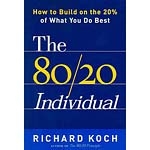 Not long ago, I wrote my post on the value of improving your strengths by only 10% (see "Related items" at the end of this post). What a lovely coincidence that, only a week or so later, I happened upon Richard Koch's book, "The 80/20 Individual".
As you may infer from the title, this book discusses a personal improvement strategy based on the Pareto Principle, better known as "the 80/20 rule." (Koch wrote this book as a follow-up to his 1997 book, "The 80/20 Principle" which I've never read).
I've been pleasantly surprised by the depth, insight, and applicability of this book.
The power of "wealth-creating" individuals and small teams
Overall, this book is about how to maximize the impact of your individual wealth-creating capabilities by exploiting your top 20% most valuable skills, ideas, and activities. Even in large organizations, a lot of the power and growth comes from small teams and their ability to disproportionately exploit the resources of their larger parent. Koch tells us that, when companies enter the Fortune 50, their growth slows down dramatically. In fact, the research he cites found that 91% of companies entering the Fortune 50 never grew substantially again without acquisitions.
His techniques are all centered on creating a growth "engine" to create wealth and achieve wild success.
An energizing presentation
Based on the title, I was expecting this to be focused on individual strength development, and I expected to see a lot of the same kinds of "psyche yourself up" techniques present in many self-improvement book. Instead, I found a holistic approach to help you deal with and maximize individual strengths as they relate to success in business. There are exercises and advice in the book to help you tune your mindset to look for your strengths, as well as case studies to help you maximinze what Koch calls your "20% spike." The 20% spike is the "thing", in any endeavor, that provides unique, game changing differentiation for people who win.
Koch spends some time discussing people like Bill Gates, Warren Buffett, and others to discuss how they've maximized their "20% spike." Anyone who's able to win by maximizing their 20% fall into a group that Koch terms, "80/20 Individuals."
The "meat" of the book is 9 chapters called "The Nine Essentials of 80/20 Success." Each chapter has a philosophy, some examples, and advice to help you apply the nine essentials.
Read MoreGood listening
I have been re-stocking my collection of audiobooks, preparing for some reading via my iPod on my upcoming trips.  If, like me, you're fond of blending audiobooks into your reading list, I've got a great resource for you.
I just found a great list of business audiobooks on John Richardson's Success Begins Today blog. I've read or heard about half of the stuff on John's list, so I'm thinking he and I have compatible reading interests - so I've just bought & downloaded a few new ones. John has been doing a lot of audiobook listening as part of his cool "MBA On The Run" program that I wrote about a while back (Manage by running around, 28 April, 2006).
Incidentally, if you decide to get your audio fix via Audible.com, I recommend either the Audible Gold or Platinum subscription plan that they offer - it's very cost-effective if you listen to books regularly, because they include book credits. You can use a credit to get any book they offer, and if you choose expensive titles you'll easily make up for the cost of your subscription. For example, I buy a lot of new or recent releases through Audible and the monthly subscription cost is cheaper than buying the hard copy of the book, and much cheaper than the audio version of the book.
Also, don't forget the tip I shared previously about how to speed up your audiobooks on iPods.
Read MorePhil's 10 Step Program
A couple of weeks ago, I received my official copy of Phil Gerbyshak's book "10 Ways to Make it Great!" I read it almost immediately, and I'm finally staking out enough time to write a review.
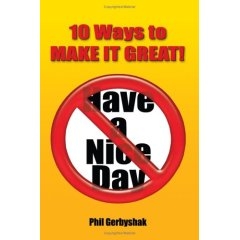 For any of you who've encountered Phil, you'll remember it - he is a high energy, positive, and encouraging guy. I've often wondered, "Where can I get some of what Phil's been eating?"
Well, in this book, Phil's bottled up some of that energy and relates some of the techniques he collected, developed, and perfected to move beyond a "nice day" world into a "great day" meme. This is a small, carry-it-with-you kind of book and it contains 10 short exercises (mini-workshops is a good way to describe them) to help you make 10 concrete, significant changes to your life.
Each of these changes is architected to drive a positive result in your life, relationships, and results. They also push for some healthy introspection to help you achieve better clarity of vision to focus your improvement. A lot of these techniques are similar to ones I've encountered along my journey of curiosity. Phil not only brings them all together in a very portable form, he adds his own unique perspective for a new angle on many of the themes.
For example, we've all heard about the power of envisioning your desired outcomes. In chapter 7, "Dream Big Dreams, Do Big Things," Phil describes how to create a "dream room" to help you create a space where you go to dream. This provides a handy way to condition your mind to get ready to create new ideas, because you have a way to "suit up" for dreaming big. Pretty cool.
As someone who tends to try to solve problems on my own, I've been trying to develop a new habit of asking for help sooner when I get stuck. Chapter 5, "Surround Yourself With Those Who Can Help You," gave me some new action steps that should help make my journey easier.
Pick up a copy of Phil's book and carry it with you (it's under 70 pages). Then, when you find yourself having anything less than a Great Day, pull out your essence of Phil and get to work!
Read More