Genuine Curiosity

Author Dwayne Melancon is always on the lookout for new things to learn. An ecclectic collection of postings on personal productivity, travel, good books, gadgets, leadership & management, and many other things.


[Review] Leadership Secrets of the Rogue Warrior

One of my mentors (Barry Rhein, the guy who gave me the words to name my "genuine curiosity") recently gave me Richard Marcinko's book, "Leadership Secrets of the Rogue Warrior." This is not a new book, and I'm surprised I haven't run across it before. But man - I am very glad I know about it now.

Marcinko's "in your face" writing style initially led me to believe this was about the most irreverent management book I'd ever read. As I got into it, I realized I'd missed the point. Marcinko is actually very respectful - to those who've earned his respect, regardless of their rank, position, etc. And, in stark contrast, he is absolutely (scathingly) irreverent toward anyone who refuses to learn how to be a better leader, or chooses to be comfortable in a life of incompetence.

The Ten Commandments of the Rogue Warrior

This book takes you through a comprehensive set of management principals by introducing you to each of the "Ten Commandments of the Rogue Warrior." Each "commandment" is explored in Marcinko's colorful way, then illustrated with vivid, memorable true-life stories that really drive the point home. Some of the stories are Marcinko's own, while others draw on great leaders of history (not just military leaders, by the way) to explain how they dealt with difficult situations in a manner consistent with the ten commandments.

I won't go through them all in this review, but here are a couple of the commandments to give you a feel for what they're like - I picked these because I learned significant new things from them:

4. I shall punish thy bodies because the more thou sweatest in training, the less thou bleedest in combat.

This one is about being prepared, but goes beyond "thinking" about being prepared. Marcinko urges businesses to conduct "war game" like exercises (red team vs. blue team) to vigorously test out strategies, and come to view your own company as your competition sees you. Very powerful.

8. Thou shalt never assume.

Excellent illustrations here about the fatal potential of relying on conventional wisdom, flawed first impressions, and thinking you know what others expectations are without confirming them.

The stories in these chapters make these commandments come alive.

The Rogue Warrior's Leadership Code

The "ten commandments" are all derived from The Rogue Warrior's Leadership Code, which has been defined, refined and exemplified by Marcinko throughout his career. The principles are:

  • I will test my theories on myself first. I will be my own guinea pig.
  • I will be totally committed to what I believe, and I will risk all that I have for these beliefs.
  • I will back my subordinates all the way when they take reasonable risks to help me achieve my goals.
  • I will not punish my people for making mistakes. I will only punish them for not learning from their mistakes.
  • I will not be afraid to take action, because I know that almost any action is better than inaction. And I know that sometimes not acting is the boldest action of all.
  • I will always make it crystal clear where I stand and what I believe.
  • I will always be easy to find; I will be at the center of the battle.

--Richard Marcinko, "Leadership Secrets of the Rogue Warrior"

Marcinko's point is this: Whether you lead in life-or-death situations, or you lead in a "normal" corporate environment doesn't matter much - you need to aspire to great principles to be a great leader. What a powerful way to lead - and live.

The bottom line: This book is a wonderful combination of inspiration, instruction, admonishment, and motivation. I highly recommend it.

One word of warning: the language in this book is rough - it's peppered with "f-ing and blanking" - but the message, concepts, and stories are golden.


Related items:

Read More

[Review] The Art of Managing

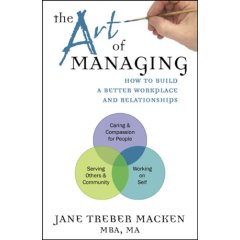
I've just read Jane Treber Macken's, "The Art of Managing: How to Build a Better Workplace and Relationships," and I quite enjoyed it. The beginning of the book felt a bit academic, sharing a lot about the history of management theory, and an overview of various management models and techniques used in the last 150 or so years. But don't let the clinical introduction turn you away - once the book gets going, the author adds a lot of interesting tools and engaging examples that make this a very good read.

The book is short - only about 100 pages - but it covers a lot of ground in a very effective fashion. Macken does a wonderful job of weaving in material from noted management experts, along with her own personal stories of life and management. She also presents some useful tools and mental models to help you become a more effective manager.

Managing by sitcom

A lot of the fun in this book comes from the way Macken livens things up with things you don't always seen in management books. For example, one model I liked exploring describes office relationship styles in terms of characters from the "I Love Lucy" and "Leave It To Beaver" television shows. I'm a cross between "Ethel" and "Ward," trying to become more consistently "Ward."

I was a huge fan of these shows, so it was a fun exercise for me (and, even if you know nothing about those television shows, Macken describes how to use the model to apply it within your own context).

A plethora of tools

Other models and tools she discusses with her own spin include the Myers-Briggs Type Indicator model, group development and conflict resolution techniques, motivational techniques, and a model for situational leadership.

Finally, she rounds it out with a great set of tools to assess the effectiveness and alignment of an organization, and discusses methods to address any weaknesses or mis-alignment you may discover.

In summary, I liked this book because it gave me some new twists on some familiar management models, as well as teaching me some new tools and techniques I can apply to become a better manager. I believe it would be equally useful to new managers and seasoned veterans.

Read More

What's Your Bottleneck?

Last night, I sat down to skim the latest book I received, "The Flip Side," by Flip Flippen. Normally, I flip through a new book (no pun intended), put the book at the end of my "To Read" stack and read it when it's that book's turn. Not with this one - I ended up reading the whole thing then, and there."The Flip Side," could very well change your life.

In case you haven't heard of Flip Flippen (you'll learn his real first name in the book, by the way - and you'll understand why he goes by Flip), he is actually a highly regarded success coach for some notable athletes and high profile executives. He uses this book to share what he's learned through years of helping others become more successful.

What's holding you back?

The subtitle of the book is "Break Free of the Behaviors That Hold You Back," and it very well could help you with that. One of the first things that really sucked me in was the book's focus on trying to help you identify and remove "Personal Constraints" that prevent you from achieving maximum success. Flippen actually refers to Goldratt's Theory of Constraints (TOC), which I've written about in the past (see "Related links" at the end of this post for links).

In Goldratt's TOC, there is always one, primary constraint that limits the effectiveness of the entire system, and you must find a way to optimize or alleviate the constraint if you ever want to maximize the results you can achieve. Flippen embraces this with the premise that you may have many strengths and many weaknesses, but there is typically one, primary Personal Constraint that is limiting your success.

In the book, you'll learn about the"Five Laws of Personal Constraints, and discover the "Ten Killer Constraints" he's isolated through years of coaching. There is one chapter on each of the ten constraints and, in each chapter, you'll have the opportunity to do a quick assessment of whether the constraint is a big issue for you personally. You answer a few questions and use your scores to guide you to your top Personal Constraints. I say "guide" because your top-scoring constraint may not actually be your biggest inhibitor (for me, I believe my #2 is actually my biggest Achilles' heel). You can even check out an excerpt to get a feel for the book.

Be sure to read up on all the constraints - there is also a section in each chapter on how to deal with others in your organization who display these constraints, even if you don't have them yourself.

There is only one constraint

Another concept Flip embraces in the book is one that is central to TOC: at any point in time, there is only one constraint, and you must focus on fixing that constraint or you'll fail. Flippen uses a golf story to illustrate this:

When he took up golf, Flippen signed on with a golf instructor. During the first session, the guy spouted a laundry list of problems with Flip's golf swing, posture, stance, etc. It was overwhelming and he never went back.

Flip then signed up with a different golf instructor. During the first session, the second guy told him exactly one thing to work on, and said, "That's all you need for now. Work on that, and we'll talk when you get that down." Flip understood, could focus, and developed that one skill. After that, the instructor focused him on another (single) new thing. And so on...

This hit home with me, just as it did for Flip. I am often frustrated because I try to attack too many problems at once (or develop too many habits, or sign up for too many things....) when, in fact, I would probably be much more successful (and happier) if I just picked on thing to improve and worked on it until I got it down. Very powerful stuff - and it's ultimately up to you.

Plan to succeed

Awareness is only the first step - now you need to do something about it. After you identify your top Personal Constraint, The Flip Side helps you develop a personal action plan (called a TrAction plan - complete with a downloadable template on the book's companion site) to help you conquer your constraint. I'm just starting on this process now, and the guidance in the book is spot on.

Still not convinced? Then you must read Chapter 16 -that's Flip's personal story, and it really drives the whole book home in a way I can't even describe. "The Flip Side," could very well change your life.


Related items:

Read More

Putting PowerPoint on a diet

One of the consequences of my dabblings with Beyond Bullet Points (see related items, below for more) is that my PowerPoints now have lots of graphics, which often makes them huge. This has made them a challenge to email, send around for collaboration, etc.

I have found an awesome solution: PPTMinimizer. This product's sole mission in life is to help you squash your bloated PowerPoint files down to a much more friendly size (and it also optimizes presentation files from StarOffice and OpenOffice). It does its job by using a number of techniques to reduce the size, including optimizing the pictures and embedded objects (like graphs that are fed by Excel data, for example) to make them more space-efficient.

You simply open one or more files with PPTMinimizer, set your options (or use the defaults like I do) and click a button to optimize the files. You have the option of saving to a new name or replacing the original, and you can also drag & drop files onto the PPTMinimizer window to add them to a list.
The coolest function, in my opinion, is it's Outlook integration. Any time I send an email that has a PowerPoint deck attached to it, PPTMinimizer displays a dialog asking me whether I want to optimize it or not. If I say "Yes," it quickly optimizes it (most files take only a few seconds), reattaches the optimized file to the email and completes the Send process.

If you want to try it out, you can download a free trial version which lets you optimize something like a dozen files. I got to about 7 optimizations and paid the $29.95 (US pricing) to buy the key to convert my copy to a full version. By the way, they offer quantity discounts and there is an enterprise version available that can crawl your local and network drives and optimize any presentations it finds.

As you can see from the screen grab I've included here, the results are impressive. I routinely reduce the size of my files by over 60% - way cool.


Related items:

Read More

[Review] Ignited!

I've been reading Vince Thompson's awesome book "Ignited!" and I want to share my findings with you. For me, one of the measures of a book is how likely I am to give someone else a copy (at the end of this post, you'll find my list of my "most often given" books). For the first time I can recall, I gave a copy of this book to a friend of mine before I even finished it -- Chapter 2 had my head buzzing.

This book is geared toward middle managers, and Vince spends a lot of time on how to improve your ability to "lead in a limited space" (I love that phrase). However, I think anyone working in an organization can learn from it, whether they're managers or not (or in the middle or not).

The book is divided into three parts, each with a distinct focus.

Figure out where the "You are here" dot is on your map

Section 1 focuses on you at a personal level -- figuring out what your opportunities, challenges, and key relationships are. This section does a great job of getting you to analyze where you are in your world, how you interact with others, and how your emotional responses can help or hinder your progress.

In the aforementioned Chapter 2, there's a technique which helps you map out your "universe" of relationships. In this chapter, Vince guides you through mapping your manager's universe, and assessing the quality of your relationships with key stakeholders to help you determine where you can contribute to make a big difference in your manager's success. The idea is that you will make your own life better if you're seen as a contributor to your manager's success. The simple tools and techniques here make this a piece of cake to do, and I think it's extremely powerful. This chapter alone was worth the price of the book for me (and you can apply the same process to your spouse, or other key relationships in your life).

Create value and light up the network

Section 2 is all about creating value for your organization by engaging others and honing your story, strategy, and interpersonal engagements to build your network of influence. In this section you focus on creating value in your organization by improving processes, becoming a better "connector" of people and ideas, figuring out what your market reality looks like, and more. There are also techniques to refine your story and clarify your strategy for driving success. Finally, you "Ignite" others in your organization to help support your activities, goals, etc. and take it to the streets.

My favorite chapter in this section deals with mapping out your landscape and tapping into the expertise of your customers to improve the quality of your "product." This also provides some good ideas for recruiting customers and partners as part of your team as evangelists.

Growing, accelerating, and sustaining

Section 3 discusses how (and why) to sell your story so you dramatically increase your impact and leverage beyond your immediate sphere of influence. This is a short, but meaty, section that discusses how to sell your ideas up the chain (both inside and outside your company), and how to effectively tackle and resolve the inevitable challenges that come up along the way. The discussion of the "right" and "wrong" ways to sell is very good.

My favorite chapter in this section is one on "Your Own Sense of Balance," which helps you understand how personal clarity, focus, and commitment are necessary but not sufficient for success. There is some advice here about leveraging your "personal board of directors," establishing a meaningful set of metrics to track your progress, and keeping yourself sane, safe, and sound so you don't burn yourself out once you've got the fire going.

In summary, I definitely recommend this book - spend a few minutes with it and you'll figure out why it's made its way on to my "most often given" list. Oh - and to find out more about Vince and his book, check out the companion site, BeIgnited (there is also an animated intro from Vince there - I thought it was very cool).


Dwayne's "most often given" books:

  • "Mastery," by George Leonard - a great gift for graduates and people going through big transitions
  • "Managing with Aloha," by Rosa Say - a tremendous book on management philosophy, told in a powerful way
  • "Two Weeks to a Breakthrough," by Lisa Haneberg - the most effective, repeatable process I've found for making blowout progress toward any goal
  • "Is Your Genius At Work?," by Dick Richards - an excellent "workshop style" book to help anyone trying to find their passion / raison d'etre
  • "High Impact Middle Management," by Lisa Haneberg - a very practical (but still very insightful) set of techniques, particularly good for new managers
  • "Ignited!," by Vince Thompson - see review above

By the way - I also give away (or refer people to) quite a few other books including all the ones you see in the left-hand column on my site, but these 6 seem to be the most "prescribed" books in my library.

Read More