
Genuine Curiosity

Author Dwayne Melancon is always on the lookout for new things to learn. An ecclectic collection of postings on personal productivity, travel, good books, gadgets, leadership & management, and many other things.


What's inside your stone?

I spent some time in Calgary and Pittsburgh this week, which afforded me some good plane time to chew through a new book I just received. Short review: Wow - you should check this one out!
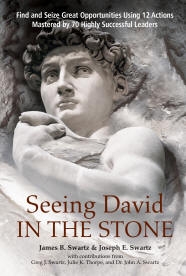
The book is "Seeing David In The Stone," by James B. Swartz and Joseph E. Swartz, and it is about how we can learn to be more effective at unlocking our opportunities and shaping our futures by studying the methods of some of the great geniuses of the past.

I think this is a great companion to Dick Richards' "Is Your Genius At Work?" which I reviewed about a year ago. Dick's book is about how to identify your personal, unique strengths, and this book provides some tremendous techniques to help you apply your genius in different ways to maximize the impact of that genius.

The book's an easy, enjoyable read and is presented as a sort of conversation between a learner and his mentor. It's a captivating story, laced with specific case studies of people like Einstein, Marie Curie, Michelangelo, Edison, Da Vinci, and a 65 other masters of their craft. A lot of the stories are from long-ago history, but you'll be pleased to find some spotlights of recent breakthrough successes, as well.

What's so special about this book?

I occasionally allude to some of the IT process consulting work I'm involved in as part of my 'day job,' but it's been more than just consulting. I've been privileged to be part of a groundbreaking research effort to observe and catalog the best known methods of high-performing IT organizations around the world. This research has led to some revolutionary, prescriptive guidance that enables any IT organization to benefit from the things the high performers have Darwinistically evolved on their own (shorten the learning curve, if you will).

"Seeing David In The Stone" has a similar feel to this IT research, since it catalogs and analyzes the practices of some of the most influential people in history. The book then provides a clear, ordered, 12-step process to help you tap into the best known methods of these highly successful leaders.

The practices are context- and industry-independent, and are well explained in the book. I read the book over the course of two flights this week, and found myself getting energized and excited about applying the principles in the book. Some of the concepts "clicked" so hard for me that I could literally feel the connection in my head.

I highly recommend this book for anyone who's involved in a creative pursuit, or who has the spirit of a learner, entrepreneur, or inventor.

Read More

Do you know what you're talking about?

I've been involved in (and even instigated) a bazillion shapeless, formless conversations in business. You may know the kind I'm talking about - you have a meeting, a bunch of folks show up, you talk for a while, and the meeting breaks up. Did you get what you needed out of the meeting? Nope.

Here are some of the things I've learned (some, the hard way) that can help make these conversations more productive - especially valuable for sales situations, partnering discussions, "buying stuff" meetings, and things like that.

Read More

When are you at your best?

As you may know from my writing here, I am something of an explorer - always looking for new things, new data, new connections, and new meanings in the world around me. Part of my energy is spent on self-examination. I'd like to share a few of my experiences here in hopes they may help you, should you find yourself in a similar "questing" state of mind.

Introspection is good

A while back, I wrote about Dick Richards' wonderful book, "Is Your Genius At Work?" and described how I was trying to home in on what my genius is, but still hadn't nailed it. Well, I still can't name it but the process heas helped me on my journey. This book has some powerful exercises to guide the curious soul.

In addition to Dick's book, I've found some strong insights through spending time with Phil Gerbyshak's book, "10 Ways to Make It Great!" (also reviewed recently). In Phil's book, there is a strong, focusing thread of, "What is it that you want to be known for, and what can you do every day to increase the odds that it'll come true?"

Seek others' input

It's easy to navel-gaze forever, but I'm also finding tremendously fertile ground in conversations I've been having with my friends and coworkers. At the recommendation of a mentor of mine I've been interviewing people I work with and asking them four simple questions, developed with help from my office mate Gene. The questions are simple and humbling (the parentheses represent what I usually say when people ask, "What do you mean by that question"):

  1. In your opinion, what am I good at?
    • (What activities are the best fit for my skills, as you see them?)
  2. What am I not good at?
    • (What activities are not a good fit for my skills, or seem particularly challenging to me, from your perspective)
  3. What is the highest value I provide to you or the organization?
    • (If I stopped working here, what would be the hardest thing to do without or replace?)
  4. How could I double or triple my value to you or the organization?

Obviously, I picked people I trust (to be honest, to keep my best interest in mind, etc.) but it's still difficult to have these conversations with people you admire or respect. Trust me - it's worth it to power through the anxiety.

One thing that can be challenging is to simply listen during these sessions. Fight your impulse to dispute what you hear, or play it down, or even lead your interviewee down a different path. Try to limit your commentary responses to, "Thank you," or, "I didn't realize that," and make liberal use of phrases like, "Tell me more...," and, "What do you mean by that?"

More perspectives lead to more clarity

My conversations validated a lot of my own perceptions about what I'm good at, and what I'm not good at. But I heard some things I never realized I even did, so I certainly never considered them to be strengths. And I found that increasing my value to others was generally not about doing more things (my tendency) - it was more about doing more of a few things. This is helping me cut out things that don't add tangible value to myself or others, which is a very good thing.

If you try this out, let me know how it works for you.

By the way - if you can't find enough people you trust to have these kinds of conversations, that's something to think about. I can think of times in the past when that's been true for me, and I'm glad that's not the case any more - that's no way to live.


Related posts:

Read More

My pod's afire

I recently had the pleasure of chatting with Lisa Haneberg about focus, energy, and getting employees engaged. She recorded it (yes, I knew she had a tape rolling) and has it posted on Management Craft as a podcast. We talked about some effective (and ineffective) corporate "focusing" exercises I've encountered.

If you'd like to give it a listen, head on over and hear the fireside chat.

This, of course, is part of an ongoing series of podcasts she's running in conjunction with the release of her new book Focus Like A Laser Beam, which I reviewed a little while ago (see the full take here).

Keep the fire burning, Lisa.

Read More