Genuine Curiosity

Author Dwayne Melancon is always on the lookout for new things to learn. An ecclectic collection of postings on personal productivity, travel, good books, gadgets, leadership & management, and many other things.


See yourself driving the car

A long time ago, I talked with a car salesman friend of mine and he told me his goal when a new prospect walked onto the lot was to get them to "see themselves driving the car." He explained that once they started to imagine what it would be like to own the car, show it off to friends, sit in it driving to work, etc. his job got a whole lot easier.

Win once to win again

From the "Influence" book I reviewed the other day, I now know this is a scientifically known effect in which people make a mental shift or "declaration" to belong in a certain category then they begin to make choices that reinforce their membership in that category. I read about this effect about a week or so ago and have noticed that others have intuitively incorporated this into their thinking:

  • My son's football coach told the team and parents that, though they are a new team, after the boys win one game they will begin to identify themselves as "Winners" and begin to win more often.
    • They won their first game on Friday night (33-12, against a team that was reputed to be better than them) so we'll see how this flavors their confidence in next week's game.
  • In a project at work, the project leader said it was important to set a few difficult but definitely achievable goals so the team could experience a win and thereby increase their probability of winning again.
  • My wife deliberately gave my daughter a simple challenge in cleaning her room so she could feel the satisfaction of achieving the objective and want to do it again.

Whether they realized it or not, all of these people have tapped into a powerful human response.

How can you tap into the power?

So, the question is: How can you tap into this for your own benefit?

A few ways come to mind:

  • Declare your future reality as though it were true today ("See yourself driving the car")
    • Begin "pretending" that you are the way you want to be, and you'll increase the number of choices you make that will bring your into alignment with that future reality. For example, if you begin imagining yourself as an efficient and productive person, you'll tend to behave more efficiently and productively.
    • If you've heard about how athletes play "mental golf" or otherwise imagine themselves doing things well, this is what's going on.
  • Talk about yourself in ways that reflect this future reality ("Declare yourself")
    • Positive affirmations are often employed by self help programs, and it's no accident - they are effective. Positive affirmations trigger the principle of "consistency" within us - we want to act consistently with the way we declare ourselves to be.
    • If we consistently declare ourselves as healthy, we'll begin to support these statements with our actions so we don't seem flaky to others.
  • Set achievable, yet meaningful goals. ("Achieve the win that brings you back for more.")
    • Once you feel what it's like to win, you'll crave the rush again - and that, in itself, will help you win again. Set milestones along your path (with some public rewards, ideally) to help you feel what it's like to succeed - you'll begin to feel like a winner, and that's a good thing.
  • State your goals specifically and publicly. ("Put your reputation at stake")
    • Again, you've probably encountered programs that get you to publicly proclaim your goals. The pressure of responsibility from public goals will help you stay motivated and can often get you to perform the extra actions that are the difference between success and failure.

These are just a few ideas to help you spark your own success. If you haven't read "Influence" yet, I recommend you do - it's awesome and very applicable to your influence on yourself and others.

Remember, success often starts with a vision, a declaration, and decisions to support what you say you're all about.


Related items:

Technorati tags: , , , , , ,

Read More

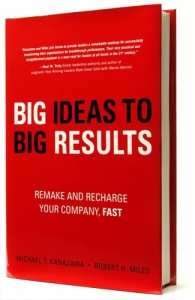
[Review] Big Ideas to Big Results

Many organizations reach a point in their existence when they hit a plateau or begin to stagnate. When that happens, they often seek a "breakthrough" in their performance. Sometimes, they succeed and sometimes they don't.

I recently read "Big Ideas to Big Results," by Michael Kanazawa and Robert Miles, which is all about increasing your chance of success when you're seeking to re-vitalize your company. This book had a unique attraction for me, since I worked with Mike and Bob on one of the transformations they discuss in the book (it was called "Taking Charge" and is referred to at various points throughout the book, but specifically summarized on page 118 & 119).

The authors have worked together on a number of corporate transformations, and they share their experiences to help us minimize the chances that we'll run the "typical" course: some lame, corporate feelgood program that achieves nothing. I've been there and it is not a fun fate.

Beware of zombies

The authors do a nice job of keeping things interesting by telling colorful stories to illustrate their points. One I enjoyed is Michael Kanazawa's discussion of "Zombie Projects" which he encountered, ironically, while working in the same area as Dilbert's creator Scott Adams.

"Zombie projects had supposedly been killed through inattention or lack of formal funding, but, in fact, they continued to live on as pet projects of key manager who couldn't or wouldn't let go."

These kinds of projects suck resources and motivation from the rest of the organization, causing "drag" on the business. The authors discuss the reasons these projects are allowed to exist and most of the book deals with how to ferret out and get rid of these kinds of useless activities.

Set the right drumbeat

Another interesting topic covered in the book deals with how leaders can make or break their team's success through the "drumbeat" they establish. Examples of leaders who to force too much "sense of urgency," which often has the opposite effect; rather than getting people to work harder or faster, their "urgency" shuts down debate and makes people feel anxious or frustrated.

They offer some powerful tips for how to manage your team's "sense of time" so that people use their times productively, without panic, and without feeling like they'll slow down progress by injecting their opinions or challenging things that are happening.

Engage the masses

One of the things that comes out strongly in the book (and one of the most memorable aspects of the Taking Charge project I was part of) is that the authors have developed a true methodology for engaging  people across a company and focusing them on a specific set of outcomes. Their construct called "Tablework" is a big part of encouraging innovative thinking and microcollaboration among small teams, which is then reconnected back into the company's larger objectives.

Perhaps the most powerful aspect of their approach is the drive to create "leaders at all levels" - crucial in creating a self-sustaining, effective business that can scale. A big part of that is letting people throughout the organization own various aspects of strategy and execution - and holding them accountable.

But one other vital aspect of this is making sure people feel recognized for their part in the company's success, and helping them discern the difference between things they must do and things they must strive for. They present the latter using a concept I really love - the distinction between "promises" (absolute goals) and "declarations" (a statement of intent when the means to get there are unknown).

Get big

This book is jam packed with information and techniques, but is fun to read. I also believe it can be a handy recipe book to help managers and leaders deal with specific problem areas, even if you don't go through the whole transformation process form end-to-end.

If you're a leader looking to drive your business out of the "same old same old" then I highly recommend Big Ideas to Big Results.


Related items

Read More

The future of work awaits you

If you're interested in the future of collaboration, location-independent productivity, and how technology will make life better, you should take a look at what's going on at the Office 2.0 conference, which is coming up September 3-5 in San Franciso.

The conference is the brainchild of Ismael Ghalimi, who already uses all sorts of online tools to be productive no matter where he is in the world, as long as he's connected. I recently heard David Allen interview Ismael, and I think he really has an excellent grasp of the direction of collaboratoin and productivity.

The Office 2.0 conference sounds excellent - you can check out the agenda, speakers, etc. at the Office 2.0 site at the link above, or just click the logo to the right.

Good news and some savings

If you are interested in attending, I have some good news - I was trading email with Ismael this weekend and he sent me a link that will get you a discount on conference registration! Click this link to get a 10% discount on Office 2.0. Maybe I'll see you there...

Other cool things about this conference

  1. They are using an awesome collaboration tool from some friends of mine here in Portland: Jive Software's clearspace. If your business wants to increase collaboration inside your company, Jive's worth a look.
  2. They have a novel approach to making the conference more interactive, and providing course materials. Every year they give out a "gadget" that you get to keep. Last year it was an iPod Nano with all the materials pre-loaded on it. This year, it is an HP 2133 MiniNote PC - way cool.
Read More

“Free” pictures for you

I use quite a few pictures, both on the blog here and in presentations I put together. Since I want to "do the right thing," I pay for all the pictures I use or get them from royalty-free sources.

Father holding baby
I was intrigued by a service called "PicApp" that is very cool for blog and other web images. It is easy to use, and has a lot of advantages:

  • You can search for a wide variety of images and select from previews, so it's pretty simple to use.
  • Images on PicApp come from agencies such as Getty Images, Corbis and SplashNews.
  • The ads on the photos are non-intrusive - no distracting watermarks.
  • Themed creative images are available in addition to celebrity photos and news and sporting events.
  • If you become a registered PicApp users can create RSS feeds for your favorite searches.

You can find some pretty cool pictures here with their search engine, and the ability to turn a search into an RSS feed is pretty interesting.

There are a few limits, as you must use their "embed" codes to use the image but they let you choose the image size, alignment, etc. and the code is automatically adjusted for you. That, and user interface is a bit quirky sometimes, but the images are pretty good. And, that being the case, these aren't the ones to use in presentations per the agreement you enter into to use the content.

As you can see by the pictures I've included here, free has some strings - since you use their embed code, you get a link back to their service as part of the bargain and (as in the cow picture) sometimes some interesting additional content or the occasional ad. But hey, it's free.

Sales In Cider Top One Billion Pints A Year

To give you a sample, here are a couple of pictures I found by searching for "curiosity" on this service.

If you write about celebrities and current events, you'll be pleased to know that this service has plenty of pictures of people like Paris Hilton, shots of things happening at the Olympics, and things like that.

Sound interesting? Check it out at PicApp!


Related items:

Read More

[Updated] Execution Revolution Review

[Update:] When I originally reviewed this book back in April, it was based on my reading of a pre-release copy in PDF form. Recently I received the hard copy and re-read the book. I liked the book even more in its finished form, and have some updated thoughts on it, reflected in the text below. I also realized just how much more I engage with a printed book vs. an on-screen book - no wonder I print out lots of PDF's to read them on the plane...

Gary Harpst's "Execution Revolution" is a book designed to get your business to the next level. I loved this book, and I think the subtitle sums it up quite well: "Solving the one business problem that makes solving all other problems easier." What's the "one problem?" Execution.

Voice of experience

If you're unfamiliar with Gary, he was the founder of Solomon Accounting (very popular software back in the 80's and early 90's when the PC industry was very young). He grew his business from a startup to a large, successful enterprise - finally selling the company to Great Plains Software (since purchased by Microsoft) for a hefty sum.

One of the things I love about Gary's methods and style is that he incorporates his own lessons learned, successes, and experiences into his books - and that makes his guidance seem much more actionable and achievable.

More than a memoir

Don't worry, though - this book is not about hyping up Gary's past. Instead, he presents stories we can learn from (like when he had to layoff half his company) and provides structure and techniques so other small-to-medium businesses (SMB's) can avoid some of the problems he encountered. The other thing I noticed very early in the book is that Gary uses tons of data to support his ideas (but I guess that makes sense from a guy who started an accounting software company).

The stories Harpst relates (his own and specially selected vignettes from other companies) rang true for me - whether he was talking about the problem with communication as an organization grows, the tendency to refrain from action even when you know the right thing to do, or problems that occur when you don't factor human nature into the difficulty of making business changes.

A book of action

This book is centered on a methodology designed to guide you through actionable steps to become better at execution within the business, with the goal of taking your business to the next level. Just as his first book focused on Six Disciplines, Harpst has focused Execution Revolution on a 6-phase system to address problems with execution:

  1. Decide what's important (Strategy)
  2. Set goals that lead (Plan)
  3. Align systems (Organize)
  4. Work the plan (Execute)
  5. Innovate purposefully (Innovate)
  6. Step back (Learn)

And the whole thing repeats.

Knowing vs. doing

Now, at a glance, you might think "OK - that all sounds obvious or familiar..." but I encourage you to see what Harpst has to say. After all, how many business have a pretty good idea what they should be doing, but are falling short on delivery and execution? Harpst has obviously been there along with the rest of us, and has devoted his attention to helping organizations break through this obstacle to become high performers.

Harpst's book goes beyond platitudes, and his recommendations are meaty and actionable.

The Power of Compounding

One notion I really liked is how Gary applied the concept of "compounding interest" to businesses operations and individual actions. He states that "...compounding teaches us our lives are built on our past," and discusses how even small decisions really matter:

"Building an organization that knows how to execute is based on how you do the little things; every goal you set, every interaction with a team member, every person you hire, every customer interaction. They all matter. And they are all compounding for good or for something else."

This whole concept is about building sustainable, thriving businesses - not just opportunistic, "flip this house" kinds of businesses - and Gary does an excellent job of making this point.

This is not a 'getting started' business book. It's a 'getting better' or 'getting results' book that is well-suited for established SMB's who are in the midst of (or in fear of) a plateau or decline in performance. If you want to jump the curve and get better results in leading an SMB, this book is one you should read.

Read More