Genuine Curiosity

Author Dwayne Melancon is always on the lookout for new things to learn. An ecclectic collection of postings on personal productivity, travel, good books, gadgets, leadership & management, and many other things.


Everything happens for a reason

I often say that "Everything happens for a reason," and that it's up to us to find out the reason. Recent reflection on this topic has caused me to alter this philosophy just a bit.

I am still convinced that everything happens for a reason, however, I am also convinced that it is up to us to define that reason within our own lives. Events have meaning because we assign meaning to them. Events only have significance when we choose to do significant things because of them.Events only have significance when we choose to do significant things because of them

In my recent post about feeling "stuck" in my action lists, I realize that a big factor in that "stuckness" is that I haven't been doing enough to create significance out of the opportunities before me. I'm not talking about earth-shattering things; more along the lines of less time focusing on things that don't matter in the grand scheme of things, and more time focusing on the things that make a difference.

A bunch of recent events and "nudges" came together to get me to this point. In no small part, I owe a lot of the credit to the blogging community where I've found a gold mine of ideas, great advice, and a lot of inspiration - thank you. Ironically, the final piece clicked into place as my wife and I were watching the movie "Envy," in which the main characters (played by Ben Stiller and Jack Black) each go through a period where their effectiveness ratings at their jobs were good for most of the year, but their performances went down the tubes when their "focus score" was poor..

So, now that I've seen the spark, what will I do differently? On the personal side, I spent a refreshing few days with the family doing fun family things the last couple of days (had a wonderful Thanksgiving dinner, saw Nemo On Ice, saw the new Harry Potter movie, got my 12-year-old son signed up for our local health club and took him to work out a couple of times, and stuff like that). And, as Lisa suggested in her comments, I stayed off of email. I intend to do plan more stuff like this.

On Monday, I am going to take a "clean slate" look at everything I'm doing at work and decide what significant things I want to achieve there. My goal is to stop sailing on the prevailing winds of urgency, stop putting off "hard stuff," and chart a course that feeds my passions and plays to my strengths as fully as possible..

This realization is simultaneously a very liberating and frightening to me, but I think that only good can come from it. And it's up to me to make that true, isn't it?

Related posts:

Read More

It ain't like brushing your teeth

Well, I've fallen off the wagon again with my Getting Things Done routine. My inbox is up to around 400 messages, I feel a bit "stuck" on a few projects, and that's not good.
Rituals

I love David's GTD methods and philosophy, but I have a recurring issue with drifting away from my good habits. A few months back, I went to one of David's GTD|The Roadmap seminars, and he talked about how we needed to develop new habits for GTD so they'd become automatic, like brushing your teeth. His story went something like this:

When you're born, you don't know anything about brushing your teeth - you didn't even have teeth. Then, when you had teeth, your parents made you go brush them every day. You may have complained, but they reminded you and you did it every day. Then one day, without realizing it, you did it without being told or asked. You'd developed a new habit!

How often do you need to be reminded to brush your teeth? Probably not very often. As an adult, if you go too long without brushing your teeth, the "scuzz factor" kicks in and the sense of urgency to go brush your teeth increases. And then you brush your teeth and the scuzz factor is gone.

Read More

Note to Wine Company: Compete with Starbucks Not Microsoft

"Friendship is the only cement that will ever hold the world together." -- Woodrow Wilson My circle of friends is changing in ways I'd never imagined. Earlier this year, Rosa Say found out I was going to London and introduced me to Adrian Trenhom, another friend of hers who lives near London. Though we know her quite well, neither Adrian nor I have ever met Rosa face-to-face (she lives in Hawaii, so you can imagine we'd love to go visit her).


Anyway, Adrian and I got together at St. John's Bread and Wine this summer, and we each brought a friend. I brought along my colleague, Christopher Morgan, as I was traveling around with him that day. Adrian brought James Governor, who happens to be an industry analyst in the industry Chris and I work in. As previously reported, we got along very well, and decided it was something we wanted to repeat.


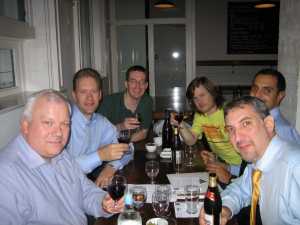
November_2005_hatfield_014_new This week, I visited London again. Chris, James, Adrian, and I all decided to get together at St. John's for a bit more wine and friendly talk. This time, James added a couple more people to the session - Neil Hare-Brown and Babur Mirza, who work for an information security company in London. James assumed (rightly so) that Chris and I would have compatible business interests with Neil and Babur (we met bright and early the next morning for breakfast to discuss this - very cool).


Click on the small version of the photo here to open a Flickr page that has annotations with a few bits of trivia about each of us. And, you can find out what kind of wine we voted "best" for the night.


This meet-up is a great example of how online relationships can turn into terrific off-line relationships.


And it all started with Rosa, my favorite connector.


The Results: Full text or snippets?

Last week, I asked whether you prefer to see introductory "snippets" or full text in the blogs you read. I also opened a survey to allow you to vote on it. Here are my findings:

High-level findings:

  1. Most of you (about 66% of those who responded) preferred full text (and even within this group, many still like [Read more...] links for loooong posts)
  2. Most of you who favored [Read more...] links did so because it made the page more aesthetically pleasing
  3. People using RSS readers tended to favor full text (at least based on the mentions in the comments)

More color on these findings:

From the comments, I classified people as "Clickers," "Scrollers," and "Straddlers" - here are some observations on each.

Clickers...

  • like to be able to quickly scan lots of article introductions
  • tend to cite the cleaner look of the [Read More...] approach as a key factor in their enjoyment
  • were more likely to read blogs and feeds while online
  • Eric Mack offers some thoughts on why he uses the [Read More...] approach in the comments to the original item
Note: a couple of Clickers gave a use case in which they scan a page, then tell Firefox to open the links in a new tab, effectively queuing up all the [Read More...] articles they're interested in for later review. Great idea.

Scrollers...

  • want to see information all in one place
  • often find the [Read More...] approach as something that breaks their concentration / continuity
  • don't like being left hanging (or just don't like to click)
  • complained that they are sometimes forced to click a [Read More...] link, only to find 3 lines of additional text that could've been on the home page anyway
  • are more likely to use offline readers to read blogs and feeds.

Straddlers...

  • like to see a flexible approach based on article length - if the article is very long, break it so the page isn't quite so busy
  • like the cosmetic benefits of links, but don't mind having medium-length posts in their entirety on the home page
  • a couple liked snippets on the home page but full text in RSS feeds (I'm not sure I know how to do this, though)
  • Bert Webb and John Richardson have some good comments (in the comments to the original item) about their philosophy on when [Read More...] links are better.

What I'm going to do about all of this

I think Bert and John are right on with their "length matters" philosophy. So, I'll continue to post full text on my pages unless I have a really lengthy post - in which case, I'll break it and continue on another page. I've even done that recently on the Never Work Alone blog.

A final note to all you people who break your posts and continue on another page

If you're a blogger, and you use the [Read More...] technique, a few user requests have come through loud and clear in this survey:

  1. Only break up your posts if their length warrants it. People get annoyed if they have to click over for just a few more lines of a post. You look like you're just trying to create more page views - and that's only good for you, not the reader.
  2. Make sure you leave enough of a summary on your home page to give people a sense of your point so they can make an informed decision about when to click through, and not wind up disappointed.
  3. Don't break in mid-thought or mid sentence. Ideally, you'll have a synopsis on your home page (like an executive summary) with the details on the click-through page.

Thanks to everyone who participated in this little study. I appreciate all your participation and input on this topic! I can rest easy knowing I've made an informed decision.

Related post: Snippets or full text?

Location: Hatfield, UK

Related post: Snippets or full text? Interim update...

Read More

[Updated] Mind Hacks

Ever wonder...

  • why does your mind play tricks on you?
  • why can you read the same sentence with the missing word about 5 times but not see it?
  • why do visualization and "mind games" work?
  • do we really use only 10% of our brains?
  • why hearing someone talking on a cell phone is more annoying than hearing two people talking near you in exactly the same environment?

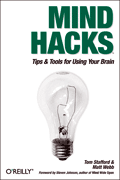
Well, you can stop wondering. I've just finished "Mind Hacks" by Tom Stafford and Matt Webb, and the answers to these and about a Brazillian other things are addressed within. This is a really fun book, and I bought it on impulse while I was on Amazon the other day subscribing to Make, and read it on a long flight today.

There are 100 "Hacks" in the book, each of which explains a different aspect of the things your brain does to make the world seem smooth and familiar to you. For example, Hack #62 explains the Broken Escalator Phenomon:

"One such phenomenon can be felt when you walk onto a broken escalator. You know it's broken, but your brain's autopilot takes over regardless, inappropriately adjusting your posture and gait as if the escalator were moving. This has been dubbed the broken escalator phenomenon."

I liked this one because I had a similar "my body is not my own" experience when I was walking on a broken "moving sidewalk" in the Las Vegas airport last week. I knew the thing was broken, but I still felt my body trying to adjust for a non-existent change in speed as I stepped on and off of the moving sidewalk.

For each Hack, the book goes on to explain how the Hack works, why it works and, in many cases, provides a fun "Hack the Hack" exercise you can try to test it out. There are a lot of references to cool things on the web like one on how to build your own "Motor/Sensory Homounculus." Yeah...that one is explained in the book, too.

Cool stuff, and lots of fun. Get it for yourself or as a gift for that special someone.

Update: Here's another sample (no pun intended) to whet your appetite.  Here's Hack #48:

"A sample of Bing Crosby's "White Christmas" has been hidden in the sound file on our book web site [link].  The sound file is 30 seconds long and is mostly noise, so you will have to listen carefully to detect when the song starts.  The song will start either in the first, second, or third 10 seconds and will be very faint, so pay close attention."

To find out about the results, pick up the book and read Hack #48: Detect Sounds on the Margins of Certainty

Read More