Genuine Curiosity

Author Dwayne Melancon is always on the lookout for new things to learn. An ecclectic collection of postings on personal productivity, travel, good books, gadgets, leadership & management, and many other things.


Show me the money debacle

Though I've been a bit quiet on the blog due to some time-consuming projects lately, I've had a bit of travel time to get caught up on podcasts. One of them was very illuminating, as it has to do with the economy and does a great job of explaining how the current financial chaos happened. The explanation was on a program called "This American Life," and the episode was number 355, "The Giant Pool of Money." You can download a transcript, or buy the audio podcast for 95 cents (I think the podcast is much more captivating, but the written transcript is pretty good).

The story gets into some of the "behind the scenes" machinations of the credit crisis, and clearly shows the value of business controls. If better controls had been in place, we'd have been able to avoid this crisis. And by "controls" I'm not necessarily talking about regulations - just added business scrutiny and business rules to detect and manage risk.

The root of the problem

In plowing through all the data about what led to this problem, it seems the culprit is something I have written about before: lack of "Tone at the Top." If you're unfamiliar with this notion, "tone at the top" is the tone set by the leadership of any entity. Tone at the top is communicated through policies, principles and, most importantly, actions taken by management. As you might imagine, it also has a huge influence on how the organization will behave - people will often get away with inappropriate actions if they can do it without any negative consequences.

Many of these financial organizations seemed willing to suspend business rigor and accept things that, in retrospect, should have set of lots of common sense alarm bells. They often felt they were doing things "in the name of competition," or for other rationales that (on the surface) seem reasonable. But the bottom line is their management allowed significant business changes without demanding a thorough analysis of the risk involved. And now we're all paying the price for weak tone at the top.

Check out the piece by This American Life, and see if you agree. And by the way - some of the things you'll hear will astonish you at how insane and irresponsible they seem.

Note: You can subscribe to "This American Life" for free on iTunes, but they only keep the most recent episode up there at any given time.

Del.icio.us tags: , , ,

Read More

Find stuff locally on your Blackberry

I've written about Samecell a few times here. It's a free utility to let you know when your friends are nearby, based on the cell towers your mobile phone signals are bouncing off of. The application will also use your GPS if it's available to provide even more accuracy. After using it for about 9 months, Samecell has been very stable and has helped me connect with friends when we happen to be in the same airport, at the same trade show, etc.

The folks at Samecell continue to improve and expand the functionality of their cool tool - and the latest addition is a local search function.

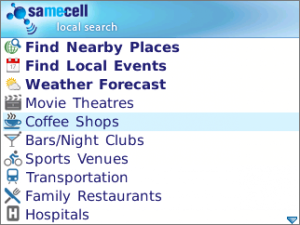
With this application, Samecell builds on its knowledge of your location to add smart searching capabilities to help you find points of interest that are nearby. If you travel a lot, as I do, you'll understand the difficulty of finding a particular type of restaurant in an unfamiliar town. Samecell Search is a great way to get the job done - you simply choose a category or keyword, send the results to the server, and you get the results back right away. The results are complete with addresses, phone numbers, and clickable web links.

And, yes, it's also free. Go check it out today. I run both the Samecell application, and the Samecell Search application.

Enjoy!


Related items

Del.icio.us tags: , , ,

Read More

What's your type?

The other day, I was having a discussion with some friends about personality tendencies and how they affect team dynamics. Many of us are "wired" a certain way, which determines how we engage with the world - some think through things out loud, while others need quiet time to process new information; some of us make intuitive leaps, while others need to see it to believe it... and so on.

One of the most interesting tools I've been exposed to for determining your personality "type" is the Meyers-Briggs Type Indicator (MBTI). This is a tool that helps you identify your preferences for processing information, interacting with others, and making decisions.

A bit about the model

There are 4 pairs of traits that define the spectrum of personality in this model :

  • Extraversion vs. Introversion: Broadly speaking, these deal with how you process information and where you gain energy.
    • Extraverts tend to gain energy from action and interaction. They talk through ideas to develop them, and feel energized in social situations involving lots of people and mingling, for example.
    • Introverts tend to gain energy during their quieter, thinking times. They tend to be deep thinkers, and often prefer intimate groups over large groups.
  • Sensing vs. iNtuition. This pair deals with how you perceive the world - how you gather information and process it.
    • Sensors are the "show me" types. They trust facts they can see, feel, touch, taste, and hear and tend to be very grounded in their thinking and are very pragmatic and data-driven. Sensors are skeptical of "gut feel" and hunches.
    • Intuitives are more comfortable dealing with abstract data, patterns, and theories. They often have "epiphanies" based on combinations of things they've been exposed to, and trust those flashes of insight.
  • Thinking vs. Feeling. These deal with how you make and rationalize your decisions.
    • Thinkers are more logical and detached in how they come to a decision. They are comfortable interpreting and using rules, frameworks, and other structured models for processing data.
    • Feelers are more apt to consider the human aspects of decisions - they are driven toward consensus, balance, and harmony in the decisions they make and tend to be influenced by compassion.
  • Judging vs. Perceiving. The final pair of traits define how you relate and present yourself to the outside world.
    • Judgers like to "have things settled" and push toward definitive decisions. They are most comfortable with clear answers and declarations.
    • Perceivers like flexibility. While they will make decisions, they prefer the option to change their mind later and tend to keep their options open.

You'll notice that each pair has one capitalized letter. The capitalized letter is used in a kind of shorthand to describe your "whole type." For example, my MBTI type is "INTJ" for Introverted, iNtuitive, Thinking, Judging. There are 16 different combinations of MBTI types, and you're one of them.

You can read one description of the INTJ type on Wikipedia - it's not 100% accurate for me, but it's pretty darned close. Why isn't it 100% accurate? Two reasons:

Read More

Learning from mistakes

I had the honor of kicking of the new month at Joyful Jubilant Learning. This month's theme is "BLUNDERIFFIX!" which focuses on the good things you can learn when bad things happen to you (or because of you).

When you're in the heat of the moment, it can be tough to see your way out of a difficult situation, but I find that I get a lot of value out of reflecting on what went wrong to extract the learning. I encourage you to write - not just think - about a situation in your life that was a failure, near-failure, debacle, etc. and try to find a positive thing you learned from it. There is something focusing and cathartic about writing these kinds of things down. If you blog, please share you learnings with the world. If not, at least consider keeping a journal so you can codify some of your learning.

Coincidentally, I saw a fitting quote from @HowardBienstock on Twitter yesterday:

"When you're going through Hell, don't stop."

It promises to be a good month of sharing - and my story is about what I learned about relying on others when I realized I couldn't be a "savior" of a tough situation. Click on over today to hear my story, and keep clicking in all month long at JJL.

Del.icio.us tags: , , , , ,

Read More

WWCD - What would Churchill Do?

Stuart Finlay sent me a copy of his book, "What Would Churchill Do? Business Advice from the Man Who Saved the World" a couple of weeks ago, and I just carved out the time to read it. The book focuses on Churchill and how we managed things during the heat of World War II -- the period of the Greatest Tests for the Greatest Generation.

In this book, Finlay takes examples of Churchill's leadership and applies their principles to daily management and leadership. He does so with great effect, and the result is a very useful book on business improvement. There are 17 chapters, each focusing on a different lesson (and the reading is easy - these bite-sized morsels are each about 6-10 pages long).

Patterns for success

As I sometimes point out here on the blog, I'm naturally a "pattern seeker" and I look for models in one area of my life that I can apply in other areas. This book feel like a perfect fit for me since, throughout the book, Finlay identifies patterns of action, strategy, and philosophy from Churchill's life and discusses how we can apply those notions in the context of our everyday lives.

But it's more than just a "here's a lesson - learn it and do it" kind of book. I found that Finlay's portrayal of Churchill's unconventional solutions to difficult problems, and the way he was open to hearing and accepting the ideas of others was very inspiring.

For example, one chapter called "Stay Passionate for Things you Don't Agree With," deals with examples of something I've heard referred to as "disagree and commit" in which you support ideas that you don't agree with in order to support the greater good - this can sometimess be difficult due to ego, but Finlay's examples illustrate the importance of being willing to do this.

I think my favorite chapters are:

  • "Dealing with the Stalin's of This World," which discusses how to successfully deal with the difficult customers (literally and figuratively) we all encounter all the time, and
  • "Entities Can't Show Loyalty," which illustrates why you can't get a team engaged without engaging the individuals on the team - groups don't embrace a cause or mission, people do.

And there are more where those came from. And, speaking of more, Finlay refers to this book as "Volume 1," implying that there are more coming. I hope so - I want to learn more from Churchill.


Related items:

Read More