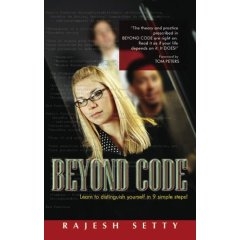
 Rajesh Setty's "Beyond Code: Learn to distinguish yourself in 9 simple steps" is one of those "luck" books I found when I wasn't looking for it. Through this excellent book, I learned a lot about the author. Rajesh Setty began writing when he was a child, and wrote his first novel before he was 10 years old in India (he got it published a few years later, which is a story in itself). Rajesh continued writing, and had six books published by the time he was 16 years old. He moved on to become a consultant, and worked on projects with companies all over the world. He became a huge value to his clients by treating their companies as if he were a permanent employee, and focusing on creating value.
All of this is interesting, of course, but "Beyond Code" isn't really about Rajesh's fascinating life -- it's about creating your own fascinating life. Many of the concepts are similar to other self-improvement books you'll read, with the tried and true guidance to write your goals down, be specific, and refuse to be constrained by others' ideas of your limits. However, this book isn't just a creative re-factoring of these concepts.
As I flipped through the book (skimming the foreword by Tom Peters), the first thing that caught my eye was that it starts with an "ROI Calculator" so you can figure out whether the book is worth your time - very cool! The next thing I noticed was the effective use of mind maps to convey ideas in the books - everything from "A mindmap of how to get the most from Beyond Code", to an illustration of the way to establish Key Performance Indicators (KPI's) so you can create a meaningful "scorecard" to track your progress toward your goals.
The overall theme of the book is "Distinguish Yourself!" which seems to be Setty's mantra, based on both this book and his blog
The "L Words" - Defining your game
The real work of Beyond Code begins with a discussion of "The Inner Game," which is about winning in the aspects of your life over which you have direct control or influence. The chapters (all starting with "L") cover specific aspects of your inner game, and offer tips on how to use each aspect to your advantage:
- Learn
- Laugh
- Look
- Leave a Lasting Impression
- Love
Next, Beyond Code moves to "The Outer Game" which is all about your interactions with others. Here, we find four more "L's":
- Leverage
- Likeability
- Listen
- Lead
For each of the "L Word" topics, Setty provides pointers, examples, and techniques to improve that particular aspect of your abilities so you can move of the curve and better distinguish yourself in everything you do.
Learn by teaching
Back in May, I wrote about how much I learned when I had to teach an unfamiliar topic to some Boy Scouts. This book applies that concept throughout the book, by providing the reader with "assignments" as new topics are introduced. Each of these includes an assignment to teach the new concept you've learned to someone else, and many are coupled with a worksheet and/or thought-provoking exercises to help you personalize what you've learned.
I found that Setty's mind maps were a huge help in this teaching process -- the mindmaps alone convinced two of my friends to get this book.
Bringing it all together
What I liked about this book was how all of the aspects came together in a tidy package - you set goals, establish personal indicators and "baseline" metrics (so you know if you're improving or not), learn new concepts, reinforce those concepts by teaching, and create your own personal growth strategy.
The book is a fast read, but I think you'll find that it has the "legs" to help you reach Setty's objective and "distinguish yourself." It achieves this by promoting reflection, decisions, and actions that will help you develop lasting, useful habits.
In summary, I loved this book. If you're still in the mood for New Year's Resolutions, this might be a great book to help make them stick. Even if you're not, this one's a must read.
For a taste of what Rajesh Setty is all about, check out his "25 Ways to Distinguish Yourself" manifesto on ChangeThis! His blog is also a slice of his philosophy and distinguishing style.
Read More

 January has been a particularly time-hungry beast, of late, so I haven't had as many cycles as I'd have liked to post things here. But - here is something you should check out - it's a very cool idea-sharing project run by Lisa Haneberg of Management Craft.
 In my day job I do a lot of work with IT organizations on best practices -- aka 'best known methods' -- and IT process improvement. I spend a lot of time working with various research bodies (such as Carnegie Mellon's Software Engineering Institute, the IT Process Institute, along with other industry bodies). Our goal is to determine and evangelize repeatable ways to improve IT efficiency and effectiveness.
 Last year, I read Rosa Say’s book, “