Genuine Curiosity

Author Dwayne Melancon is always on the lookout for new things to learn. An ecclectic collection of postings on personal productivity, travel, good books, gadgets, leadership & management, and many other things.


Cold feet in England

I’m traveling in

England

this week, and am wondering what the deal is with duvets.  For those of you who are unfamiliar with duvets, they are like a comforter with a cover on them.

They are quite comfortable, very warm, and all that.  However, in the hotels in Europe, they are used as the only top cover on a bed.  This creates two problems for me:

1)      Temperature regulation issues

2)      Cold feet

With regard to temperature regulation, I favor the layered approach of American bedding – a bottom sheet, a top sheet, then a bedspread, comforter, and/or blanket.  Like layered clothing, this provides a large range of adjustability to accommodate various temperatures.  In European hotels, I get the same duvet all year round and it’s either on or off.  That’s just not enough choice for me.

The cold feet come about because the duvet isn’t generally tucked in at the bottom (and if I tuck it in, it’s too short.  I’m 6 feet, 4 inches tall (193cm) so my feet tend to hand out the bottom of the duvet so I get cold feet.

I’d love a middle-ground approach – give me a top sheet between that bottom sheet and the duvet, and I’d be golden.  Especially if I could tuck it in.

Read More

Lifehack: Laptop screen protection

For quite some time I've used a 3M Privacy Filter for my laptop screen. It keeps prying eyes from my seatmates away (useful when I'm doing things like studying budgets, dealing with personnel reviews, etc. on planes).

The problem is that these privacy filters get scratched up over time since they rub up against my laptop keyboard (to a lesser degree, my laptop screen got keyboard-shaped scratches and wear marks even before I used the privacy screen).

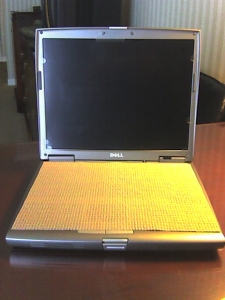
Last year, I came up with a lifehack that helps prevent this. I used that rubberized shelf liner stuff to make a pad to go between my keyboard and the screen. It not only adds a bit more cushion to protect the screen, it also prevents those scratches (click the picture for an enlarged view).

  • Pick a color that coordinates with your laptop, so you can be truly fashionable.

  • Cut a rectangular section to fit within the outer bounds of your screen (you can use scissors for this, or I like to use the paper cutter at my office).

  • Place it in between the keyboard and the screen when you close your laptop.

Voila - you prolong the life of your screen at a very low cost.

By the way - I previously had a black sheet of this, but I lost several of them because I'd forget about them on dark planes. I switched to the lighter shade you see in the picture and haven't lost one in a while.

Read More

Somewhere, somebody's praying

Well, I'm back from my family reunion and reflecting on the connections and reconnections of the past week.  We not only had a reunion (around 50 people were able to come), we celebrated my grandmother's 90th birthday about 4 months early since it's easier when the kids are out of school.

We were all particularly grateful to spend the time with my grandmother - you see, she had congestive heart failure about a month ago and the doctors told us she probably wouldn't make it out of the ICU.  I'm happy to say, she was well out of the ICU and able to hang out and have some of her own birthday cake with us last Saturday.  She's a strong woman, that's for sure.

After the reunion we went to my aunt's house, chewed the fat, and set off fireworks for the rest of the evening.  Later on, I received a copy of a prayer that my great grandmother wrote in her family Bible 30+ years ago. 

I like to believe, in some mysterious way, her prayer helped my grandmother muster the strength she needed to make it to the reunion.  Here is the prayer:

Dear God, this is the hour in my day the lull begins and I find myself alone.

Oh God, all my children are beyond my sight and voice.  They live and move, but not beyond thy care.  Guide these precious ones of mine and yours. 

Keep them from all things that make them weak and lesser souls.  God be with my dear ones all this day...

Amen

Read More

Book Review: "Now, Discover Your Strengths"

I just finished reading Marcus Buckingham and Donald O. Clifton's book, "Now, Discover Your Strengths."

As the title implies, the book seeks to help you identify your strengths and then spends some time discussing how you can capitalize on those strengths.  It even has an online assessment you can take to identify your top 5 strengths (you need to enter a unique code that is printed on the book jacket to register for the assessment).

All of this sounds really cool but, I must say, the book and quiz really left me wanting more.  There was nothing revolutionary here for me - perhaps because I've read lots of books of this ilk, and I found this one to be rather basic compared to others I've read. 

The analysis of my strength areas seemed fairly on target (in their terms, my strengths are Intellection, Learner, Connectedness, Ideation, and Input).  However, I didn't get a lot of substantive information on how to develop those strengths, what kinds of people I should associate with to counterbalance my strengths, or anything like that.

The book also contained a fair amount of material on how to use this method as an organizational development tool.  With good faciliation, that might be helpful since it would provide a way to play to the various strengths within the team (though I have been through some great team workshops with other tools).

In summary, I felt this book was a good introductory-level book, and if you're just getting into self-analysis and self-improvement, it could be very useful. 

If, on the other hand, you've had experience with things like the Myers-Briggs Type Indicator test, the Keirsey Temperament Sorter, the Birkman Method, or other tools like them, you may not find a lot of additional learning in this book.


By the way - the tools I mention above are not free, and generally require a paid facilitator.  If you're just dabbling, you can get a good (free) approximation of them by taking HumanMetrics' free Jung Typology test. Then, you can read more about the various types online or in the books Please Understand Me II, or Type Talk at Work.

Read More