Genuine Curiosity

Author Dwayne Melancon is always on the lookout for new things to learn. An ecclectic collection of postings on personal productivity, travel, good books, gadgets, leadership & management, and many other things.


I suppose this could be useful if I had amnesia?

I was just looking at someone's profile on LinkedIn, and browsed their connections. Since I'm one of their connections, I am on the list. However, I am not sure I really need a little flag labelled "YOU" to recognize my own name...

It seems I've had a visit from Captain Obvious.

Read More

Go to the extreme

I've recently "flashed back" to some advice that a friend of mine gave me about 10 or 12 years ago, and have been striving to apply it more lately. Basically, his advice was this:

"When you're trying to make a decision, force your feelings about the issue to one extreme or the other, and act on the decision with vigor."

This is a bit like the mantra "Go big or stay home" that was popular a few years back. Basically, this philosophy provides a sort of focusing tool, helping you get out of the middle ground and take a decisive postion on the matter at hand. For example:

  • Avoid ambivalence - decide whether you love or hate an idea before stating your opinion.
  • Don't take on a task half-heartedly - decide that you are going to attack it with all your abilities, or decide not to do it at all.
  • If you offer to help others - decide to give them your best, or don't offer your help.
  • If you love someone - love them no matter what and make sure they always know it.

These are just a few examples, and everyone's decisions and circumstances are different. However, according to my friend, these kinds of "extreme" stances will help you live a life of vivid color and meaning, rather than one painted in shades of gray.

Another aspect of this we discussed at great length: What if you decide you hate something? Should you attack it with great vengeance? Usually, no -- just get past it, move away from it, and don't let the things you hate take over your life.


Related items:

Read More

Management by marching around

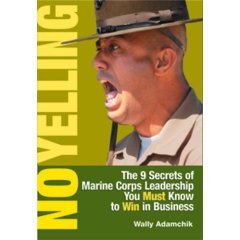
When I first heard about the book "No Yelling: The 9 Secrets of Marine Corps Leadership You Must Know to Win in Business," by Wally Adamchik, I was intrigued. I've never been in the military (though my father and grandfather were). As such, I don't have any real-life context for what their management style is like. However, I've worked with some awesome people who had tremendous business and organizational skills that they picked up in the military, and I wanted to see if this book would be useful to me in my work.

Let me start with this: Wow - am I glad I decided to read this book!

This book takes 9 core principles of management and gives each of them a chapter. The topics are:

  • Integrity
  • Technical Competence
  • Set the Example
  • Self-Awareness
  • Take Care of People
  • Make New Leaders
  • Commander's Intent
  • Culture and Values
  • Rehearsals and Critiques

This book is not preachy, dry, or mechanical. It is not rigid and robotic. This is a tremendous collection of object lessons to convey the essence of each of the 9 topics, and provide vivid examples of what these principles look like when they are applied effectively. There are also some great stories that illustrate the risks of operating in conflict with these principles.

Adamchik does a masterful job of framing each of the topics, and weaves his collection of anecdotes together with insightful commentary on why they are essential, why they are effective, and how things fall apart in their absence. You also get a clear example of how communicating trust, practicing effective delegation, and other practical skills can accelerate the development of a team.

Full spectrum storytelling

Inside this book, I found a full spectrum of stories - funny ones (such as one that occurs when he gives a vague instruction like, "Go do something productive." - and hilarity ensues), serious ones (such as one in which a commander takes full responsibility for a mistake made by junior members of his unit), humbling ones (as in stories that show the power of "being a part of the team" as a manager), and much more.

I also came away with some areas where I felt compelled to do better in the future than I've done in the past. What more can you ask for in a book?

Pick up a copy and you'll see "Semper Fi" in a whole new light - and you'll probably pick up some insights that will help you grow as a leader.


Related items

Read More

I feel a disturbance in the store...

And now for something completely different: I recently found out about a hilarious video series on YouTube about "Chad Vader - Day Shift Manager." Chad Vader is the "less charismatic brother of Darth Vader."

If you haven't seen this yet, you need to check it out - especially if you're a Star Wars fan. There are currently 6 episodes - here is Episode One to get you started.

Then, check out the rest of the episodes (for best results, watch them in order). By the way - in my opinion, Episode 6 is the best of them all. Enjoy!

Read More

Leadership made simple?

No, I don't profess to have a magic answer to this problem. However, I've just finished reading a book with a view on this. It's "Leadership Made Simple," by Ed Oakley and Doug Krug and it has some practical insights to help deal with some challenging topics for leaders.

They present a well-organized, concise "Framework for Leadership" (apparently they've trademarked this term), which provides techniques, guidance, and examples to help improve team performance. This book is a quick, engaging read and could be very valuable, particularly if you have team dynamics issues you're dealing with. I also feel this book could be a good add to the library of a new manager / aspiring leader.

This book provides a nice blend of philosophical guidance, coupled with some specific techniques for working through organizational alignment / organizational change management quandaries.

There are some great examples in the book that underscore what I like to think of as "management curiosity" - seeking to understand and learn from each situation the team works through. You'll find some excellent things for your toolbox in the section on Effective Questions, and a discussion of the relationship between good questions and the quality of the answers you receive.

Along the same lines, I found the "Questions To Think About" topics at the end of the major sessions particularly insightful, and the anecdotes in this book were very well constructed.

A difference of opinion

In fact, one of these anecdotes brought out an issue where my opinion differs a bit from the authors'. In the book, there is a discussion about the value of "Focusing Forward" to drive success in the future.

"Joy does not occur when we focus on what's not working - on our mistakes and failures. Instead, we facilitate joy in the workplace when we focus forward - on what is working, the successes we have already achieved."

OK, so I don't totally disagree with this notion, but I feel you lose a lot of learning if you ignore your mistakes and failures. It's like a mentor of mine once pointed out to me:

A lot of sports teams find huge value in reviewing tapes of past games to identify areas where they made mistakes, and trying to consciously understand why they made those mistakes in the past.

If you approach your mistakes and failures with a spirit of learning and growth, you'll get a lot more out of life than if you just ignore them.

In any case, I enjoyed this book and will hang on to it and refer back to it for some good tools.


Other titles to consider

  • If you're in the market for a more "how to" guide, I recommend you also pick up a copy of Lisa Haneberg's "High Impact Middle Management."
  • Another excellent book on achieving organizational alignment is "Execution," by Larry Bossidy and Ram Charan.
  • Finally, if you want to get into the zen of leadership, pick up my favorite "why to" book, "Managing with Aloha," by Rosa Say.
Read More