Genuine Curiosity

Author Dwayne Melancon is always on the lookout for new things to learn. An ecclectic collection of postings on personal productivity, travel, good books, gadgets, leadership & management, and many other things.


"You wouldn't like me when I'm unproductive..."

I read an awesome post by Tim Ferriss (author of The 4-Hour Workweek), on Time Management Guru-itis: Mark Hurst vs. David Allen and Tim Ferriss. It's quite an interesting analysis, and I think it is pretty accurate and insightful.

One of the interesting differences in Tim's dealio is that it's very much about how you feel as you live your life - not just how productive you are. As Tim puts it:

"Is responding to all inquiries on a moment's notice really success? I would argue it is a reactive mode that precludes life, at least the type of life I want to have."

I must admit, this is one of the things I often struggle with. Getting my balance slider bar set to the right setting is tricky. Why? Well, the optimum setting for balance can vary depending on the demands (or lack thereof) stemming from work, personal life, etc. There is the flip side, as well, in which you "impose" a balance setting on your life, then make your activities fit that setting.

Ferriss and David Allen (of GTD fame) both offer methods to impose your own balance setting, but they have completely different approaches for how to get there. I've learned tips, techniques, and philosophies from both of them, and I think they have both impacted my thinking far more than I ever expected.

Check out Tim's analysis and join the conversation (and thanks to Matt for pointing the article out today).

Read More

The Parking Lot Rules

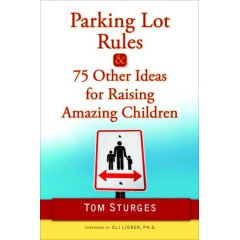
I've just finished reading a book I wish I'd had when my first child was born. It's Tom Sturges' book, Parking Lot Rules & 75 Other Ideas for Raising Amazing Children. This book is a set of pragmatic "rules" to help provide a safe, nurturing environment for kids as they grow up. Some of these techniques would have saved me some stress if I'd known about them 15 years ago when I first became a father!

To get a flavor for the excellent advice in this book, check out the rule the book was named for, Parking Lot Rules:

"In a world inhabited by cars the size of small houses, the parking lot can be an incredibly dangerous place. The drivers of these SUV's are in another world: watching their own children, talking on their cell phones, listening to the radio. The last they they are looking for is your brood. Teach your children that they need to be right next to you whenever you are in a parking lot. There is to be no trailing behind and no racing ahead. The moment you near a parking lot, call out "Parking lot rules," and your children will know that they absolutely must be by your side. This rule can also apply to any time you perceive a danger that your children have missed: perhaps raised voices or the sound of broken glass or a stranger acting erratically. It beats yelling, "Look out for the crazy guy!"

And this is only one example - just about every rule hit the mark for me, and they're very practical (I love the Bon Jovi Rule, the Truth Reduces Punishment by 90% rule, and The Power of Forgiveness).

This book is ideal for parents of young children, but most of the rules still apply for older kids and teens. I think Parking Lot Rules will become one of my default gifts for new dads. It's a beautiful collection of advice.

Read More

Executive Stamina

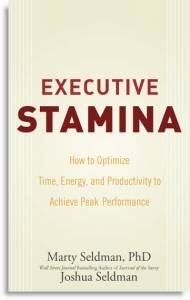
In another example of a book that comes into my life at an opportune time, I have been reading a book designed to help you systematically achieve higher productivity and better "balance" in life. The book is "Executive Stamina: How to Optimize Time, Energy, and Productivity to Achieve Peak Performance," by Marty Seldman, PhD and Joshua Seldman and I am hooked.

This book is similar to another book I've read and liked (but never reviewed) called "Find Your Focus Zone." However, I find Executive Stamina to be more "prescriptive" -- and its focus and style resonated better with me.

One of the authors of Executive Stamina is a clinical psychologist who's done corporate coaching, and the other is a respected cycling and fitness coach. They combine their respective disciplines in an interesting way, producing a guide that is designed to help people manage the natural peaks and valleys of mental and physical energy.

Stop the Thrash

This book is more than just an energy management guide - it also presents some very powerful exercises to help you improve the results you get in life.

Essentially, Executive Stamina seeks to keep you from "topping out" in your career - reaching that point where you hit a performance / interest plateau from which you cannot recover. As shown in the diagram at right, from the book's introduction, the key is to avoid reaching the point of diminishing returns in your work - avoiding what I like to refer to as "thrash."

The book is divided into 5 major sections, each focusing on models and assignments to deal with a specific aspect of your life - resulting in a combined set of skills to keep you out of the Danger Zone shown on the chart. Here is a brief rundown of what you can expect in each section:

  • Work / Life Alignment
    • This section focuses on introspection and answering hard questions about your priorities, values, etc. with the goal of helping you reach your career sweet spot.
    • This was by far the most difficult section for me, since it prompted me to revisit past situations in which my choices probably weren't well-aligned with my values. For the same reason, this was also one of the more impactful sections of the book.
    • My favorite tool in this section was the "Minimums and Shifts/Drifts" model, which is a tremendous focusing tool to drive specific action towards goals, and identify shortfalls quickly while you can still do something about them.
  • Building Your Stamina
    • This is a very prescriptive section, primarily dealing with stress management, exercise, nutrition, and other aspects of physical health & stamina.
    • I had a lot of favorite tools in this section:
      • the Lifelong Fitness Plan
      • the instructions on Meditation and Breathing Exercises
      • the comprehensive guide for "Workday Yoga" which includes yoga exercises designed to be performed at work.
  • Optimizing Job Performance and Results
    • This section focuses on getting better at finding and focusing on high-payoff activities - increasing your win rate, and raising the value of your output.
    • The tools in this section are very simple, and very much aligned with many of the productivity/time management frameworks I know and love. I particularly liked the portions on "Dealing with Toxic People" and the tips and techniques for overcoming procrastination.
  • Career Management
    • In this section, the authors focus on the fact that there is a big difference between high productivity and reaching your peak potential. With that in mind, they arm you to tell the difference between the two.
    • This section is still about personal elements of your performance, and provides a lot of guidance on preventing career mis-steps. However, it goes further and pulls in tools to help you look outward to figure out when other people are discounting your achievements, so you can prevent them from hampering your progress.
    • My favorite tool in this section is the one on Organizational Savvy, which includes the "Org Savvy Chart" to assess your strengths and weaknesses in this area.
  • Personal Relationships
    • The final section of the book emphasizes that personal relationships are a thread that winds through all of the previous chapters - personal relationships play a significant factor in reaching your peak potential.
    • Interestingly, this section describes how you can apply the tools from previous sections to systematically set goals and improve your relationships by focusing on high-payoff aspects of those relationships. Very cool.

Hopefully this gives you a taste for this book. It's smart, actionable, and well written, and I think it is a must-have for any executive (or anyone who aspires to be "master of their destiny").


Related items

Read More

Rich Idiots

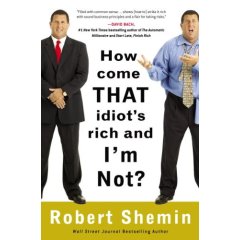
I flew back from European business trip the other day and, as usual, did a bit of reading on the plane. One of the books I read was Robert Shemin's "How Come That Idiot's Rich And I'm Not?" This was a different sort of business book than I expected, from a few of perspectives.

First, the author introduces a lot of contrarian thinking about how to get rich - he firmly believes that conventional thinking about wealth and opportunity prevent most people from becoming wealthy. Second, he provides a lot of very specific steps to become financially successful. Third, he spends a lot of time on philosophy and your outlook on life, in an effort to help you get past preconceived notions about how to make money.

Here's the pitch...
Initially I was a bit turned off by this book, because a lot of the book leads toward a methodology that Shemin offers on his web site and it felt a bit like a late night infomercial (Shemin's program centers around real estate investment schemes). As I read through it, I found myself taking a lot of ideas away that apply whether you use his system or not, and applicable even if you never get into real estate.

For example, there is a section I really liked about "Forgiving and Committing," which I think applies to many situations in life. Shemin even includes "Forgiveness Scripts" to help you learn to ask for forgiveness from friends, family members, and yourself. And don't think asking for forgiveness gets you off the hook - he is very clear that you're still accountable for your actions even if people forgive you for them.

The part about committing provides a clear and concise process to clarify goals and commit to them in an action-centric way. The concepts will be nothing new here, but Shemin's explanation is very easy to follow and will help you get through the fuzzy front end of deciding what you're committing to.

Relax - good things will happen

Another theme in the book relates to the power of positive thinking. Yes, the concept has been around pretty much forever, and has been reinvented in "The Secret", "The Power of Intention," and other books in recent years. In spite of this being an old concept, I find myself learning or identifying with the concept a bit better through each author's adaptation of this model -- and Shemin's take on it in this book is no exception. He has some great stories (some which sound to good to be true, and he acknowledges that in the text but insists they are absolutely true), detailing how various people's lives improved through positive imagery, keeping an open mind, and going out into the world to embrace success. I have seen enough examples of this in my own life to know there is something to it, and found this book's treatment of this concept to be very energizing.

On to the "doing"

The first half of the book is focused mostly on getting your head in a good place and getting to a point where you are able to look beyond some of your preconceived notions about success. In the second half, the author begins to take you into the details of how he has become independently wealthy (in spite of having a severe learning disability and being labeled as an "idiot" by at least one of his teachers, by the way).

The "doing" part of the book deals with how to save, how to invest, how to use credit responsibly, how to create meaningful objectives and action plans, and -- of course -- how to get into the real estate investment business. It's very well written, and quite intriguing.

Summary

As I mentioned early in this review, I enjoyed this book much more than I expected to. According to Shemin's thinking, the very reason I was inclined to write it off as an informercial is the very reason I'm not yet a Rich Idiot: I'm stuck in my "right side up" thinking and I need to turn my thinking upside down. We'll see how I do with that...

Read More