Genuine Curiosity

Author Dwayne Melancon is always on the lookout for new things to learn. An ecclectic collection of postings on personal productivity, travel, good books, gadgets, leadership & management, and many other things.


[Review] The Offsite

"Do you think Martin Luther King, Jr. could have rallied a nation if he'd said 'I have 10 measurable objectives' instead of 'I have a dream'? I haven't had much discretionary time lately, so my "To Read" stack is a bit thick lately. However, on a cross-country flight this past Thursday, I read Robert H. Thompson's book: "The Offsite: A Leadership Challenge Fable."

As the name implies, the book is about a leadership offsite, and it's written in a narrative, fable form similar to books like Lencioni's "The Five Dysfunctions of a Team" (another great book that I've read a few times but haven't reviewed here).

The Offsite is a bit slow at the beginning - there is a lot of setup to help you get to know the characters better - but it gets interesting about a third of the way in, including some unexpected drama that happens away from the offsite, which the story even more interesting.

The Offsite takes us through a set of techniques through which a couple of "flatlining" organizations seek to break out of their performance problems. Through the story, I really felt myself identifying with a couple of the characters and was nicely drawn into the story. In fact, I wanted to go find the VP of Sales in the story and shake him for being such an idiot at one point!

5 Practices for success

Through this story, I learned about 5 "practices" that help people become excellent leaders:

  • Model the Way
  • Inspire a Shared Vision
  • Challenge the Process
  • Enable Others to Act
  • Encourage the Heart

These 5 simple titles don't really do justice to the ideas they represent, but I think the author does a good job of bringing out the essence of each of them in the book. These practices are based on The Leadership Challenge, which was created by Barry Posner and Jim Kouzes.

The concepts in this book helped me better understand "servant leadership," which I've heard a lot about but haven't yet researched enough to do it justice (but I assure you I will now).

Clicking concepts

Overall, this book was a great read and went very quickly. In addition to driving me to dig into an assessment tool called the "LPI" (Leadership Practices Inventory) which figures prominently in the book, I really liked several concepts from the book.

  • The Commitment Circle, which deals with expanding the people involved in your decisions, projects, etc. to bring in a much broader perspective within your sphere of influence;
  • Several exercises that are modeled in the book, dealing with establishing goals and specific actions to achieve them (yes, I know - every personal development book has that - but this one does it well);
  • A tremendous illustration about the power of being "vulnerable" to you staff and letting them know what you need help with, what you are struggling with, etc.

Compelling visions

One of the anchors presented in the book is a clear, inspring, unifying vision (whether for one of the many teams you may be a part of, or for yourself). A couple of sentences from the book sum it up nicely:

"Do you think Martin Luther King, Jr. could have rallied a nation if he'd said 'I have 10 measurable objectives' instead of 'I have a dream'? Leaders share their dreams, folks. They breathe life into their visions and communicate clearly for understanding."

The Offsite is a great addition to your reading list if you want to become a better leader, are struggling with ineffective leaders in your organization, or want to learn techniques to energize and unify a team.

Read More

Back of the Napkin - free teleseminar

I just found out that there is a free teleseminar coming up on July 9th for Dan Roam's book, The Back of the Napkin: Solving Problems and Selling Ideas with Pictures. Joining Dan on the call will be Seth Godin, Anil Dash and Rich Sloan so it will be very good, I'm sure.

If you recall, I reviewed The Back of the Napkin last week and I think it's awesome (that's Dan over there on the left).

You can register for the free seminar or find out more at Dan's blog.

Read More

The Back of the Napkin

The other day, I was on a conference call with Cliff Atkinson (author of Beyond Bullet Points) who was training a group of folks on How to Create Your Graphics LIVE on a Tablet PC, Whiteboard or Piece of Paper (one of his weekly e-Lessons). One of the tips he gave us to get better at ad-hoc presentations was to read Dan Roam's book, The Back of the Napkin: Solving Problems and Selling Ideas with Pictures.

Seth Godin's review (see the diagram at right , from the dust jacket of the book) says it all. This is a very interesting book, and I've already applied some of the concepts from the book to improve a couple of whiteboarding sessions at the office.

The gist of it is to use drawings instead of dry slides or wordy diatribes to explain your ideas. Instead, engage the audience by creating simple diagrams to illustrate your points. The big problem I have: coming up with good graphics to illustrate my point. I am finding that a) practice helps, and b) if I am planning to do a talk, part of that planning should include brainstorming how I can tell the story better with pictures, and deciding which pictures to use.

The book is full of examples, along with techniques to help you come up with visual methods to present various topics and problems in a compelling way. For example, you'll find chapters on:

  • Pictures that solve a Who / What problem
  • Pictures that solve a How Much problem
  • Pictures that solve a Where problem
  • Pictures that solve a When problem
  • Pictures that solve a How problem
  • Pictures that solve a Why problem

And even if you don't choose to do everything in pictures, you'll find techniques that will help you structure and simplify your message for greater effectiveness.

This book isn't just for people who do presentations all the time. I bet you'll find that the skills you'll develop by studying and applying the approach in this book will dramatically increase your effectiveness in meetings, and improve your ability to "sell" your ideas to others.

Read More

Review: Divide or Conquer

Management books typically aren't riveting. This one grabbed me from the start.

It's Diana McLain Smith's "Divide or Conquer," and the thing that grabbed me were the stories / case studies presented in the book. The first "meaty" one analyzes the "Steve Jobs and John Sculley days" of Apple, and does a phenomenal job of breaking down the dynamics, dysfunctions, errors, and blind spots that caused all kinds of turmoil at Apple, ultimately ending in Steve Jobs being removed from his job.

The interesting thing about this case study and some of the others in the book is that Jobs and Sculley were friends in the beginning, but parted with bitterness and frustration. This kind of thing happens all the time in business and personal relationships, and this book seeks to help us understand why and suggests ways to prevent it from happening.

I see dead people

The first key is to be able to recognize the signs when things are on the wrong path. Smith provides some great models, examples, and techniques to help you here. More importantly, she provides some tools to help you push the reset button and try to get things on a healthier trajectory.

Brilliant stuff, and very practical.

Not navel gazing

A lot of books about improving communications and relationships seem very touchy-feely and don't seem like things that would work in the world I live in. This book's not like that. Sure, there are plenty of things about feelings and emotions, but the approach is a bit more logical / clinical than I usually see in these sorts of books. I really like it because it deals with people's egos and insecurities, but in a way that seeks to find out what's going on behind the actions, and provides suggestions for how to improve and change the situation, rather than just getting better at sucking it up.

In short, this is an excellent book if you are trying to improve the dynamics of your relationships - particularly work relationships where you are dealing with lots of egos, turf wars, and things of that sort.

Read More

Total Workday Control

In my continuing quest for methods and tools to make me more productive, I've been reading and applying Michael Linenberger's latest techniques from the 2nd edition of his book, Total Workday Control Using Microsoft Outlook. As I've chronicled here in the past (see "My GTD Odyssey"), I have been a follower of Michael's methods for a long time.


One of the reasons I liked them is that they were more prescriptive than -- but still philosophically compatible with -- David Allen's "Getting Things Done" (GTD) methodology. I found Linenberger's instructions to be more actionable and specific, and they helped me sustain my productivity better than GTD alone. As I mention in my GTD Odyssey posts, with GTD I missed the "go to the list; get next task" feel that I remember from my old Franklin/Covey days - and Linenberger's method feels more comfortable in this regard.


"Manage Your Now"


In this second edition, Linenberger has raised the bar again and introduces more techniques, workflows, and Outlook tweaks to help make things easier. He's even moved beyond "Total Workday Control" to establish a methodology he refers to as "Managing Your Now" or "MYN" for short (I suppose everybody's gotta have a 3-letter acronym, or TLA, these days).


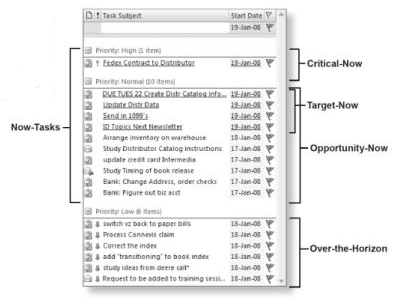
The book walks you through a step-by-step sequence for setting up Outlook for better email, task, and calendar management through the use of customized views to help you filter the information you must deal with to get your work done (the book's example of the Task view is at right).


MYN involves managing to a "Now Horizon" and segmenting your tasks. Basically, you are able to create several tiers of priority:


  • Critical-Now: the 1-3 tasks that must be done today
  • Target-Now: high priority items that you would like to do today but are not urgently due
  • Opportunity-Now: medium priority items that need to be done soon, and could be done today if the right opportunity presents itself
  • Over-the-Horizon: items that are on your lists, but you've consciously pushed them out for future consideration

This filtering and sorting method has made it much easier for me to become more methodical about working through the tasks on my lists, and the views described in the book provide a sort of "at a glance" cockpit to help you pilot your day. Find out more in the sample chapter available on the book web site.

The right tool for the job


You can go through the book and manually set up the views, but I recommend using a tool described in the book instead: The MYN special edition of ClearContext IMS. This not only automatically configures all of the special MYN views, it offers a ton of very easy-to-use shortcuts to help you become more productive with Outlook. The features are numerous, efficient, and sooo useful. I've been a loyal ClearContext customer for at least a couple of years now and couldn't live wthout it.


By the way - even if you choose not to adopt Linenberger's methodology, I highly recommend ClearContext. You can get the regular, non-MYN version at the ClearContext web site, and they even offer a 30-day trial so you can find out if it's a fit for you.


Some examples: I love being able to file a whole topic thread automatically, schedule follow-up tasks automatically, and use ClearContext's "Unsubscribe" button to make irrelevant email threads disappear

Commit - don't dabble

As I mentioned above, this book is much more prescriptive than the first edition. One of the asepcts of that is that it really requires a commitment for a few weeks to really develop new habits so you can get the benefits of Linenberger's methods. I think it's absolutely worth the commitment - I don't have exact metrics, but I think the books claims that you can increase your efficiency by 25% to 45% are in line with actual results.

And I also recommend taking a 'baby steps' approach to adoption, and focusing on the front half of the book to become proficient in the basics of task, calendar and email management before moving on to the more advanced topics later in the book (like project management and Goal/Project/Task management).

Summary

Total Workday Control Using Microsoft Outlook can truly help you "Manage Your Now" whether you're an accomplished GTD user or someone just getting started on the path to gain control of your workday. Just make sure you stick with it for a few weeks (21 days is a good rule of thumb) to ensure you get the benefits.