Genuine Curiosity

Author Dwayne Melancon is always on the lookout for new things to learn. An ecclectic collection of postings on personal productivity, travel, good books, gadgets, leadership & management, and many other things.


Jedi Mind Tricks: Influence

I've just finished my first (and certainly not my last) reading of Robert Cialdini's book, "Influence: Science and Practice (Fifth Edition)." I must say: I'm impressed by this book.

Influence is an interesting combination of scientific research, practical advice, and loads of case studies illustrating how humans are "hard wired" to respond to certain situations. The book provides guidance on how to use this psychological "wiring" to influence others' decisions.

Use these powers for good

First, this book is - literally - a textbook. Cialdini presents focused chapters, followed by thought-provoking review questions and exercises that really drive the points home. Many of the examples in this book analyze well-known ploys from consumer sales, such as sneaky car sales tricks, "sweet deals" that make you feel like you've been taken after you've agreed to them, and manipulative questioning techniques.

While many of these techniques can be used for unscrupulous reasons, there are two great reasons to study them:

  1. They can be used for good purposes - not just bad ones.
  2. Once you recognize them for what they are, you can defend yourself against them. And Cialdini even tells you how to fight back when you recognize that you're being swindled by one of these manipulative tricks.

Please promise me you will not order this book if you have any plans to use these techniques for evil purposes.

Automatic responses

One of the things that makes the "tricks" studied in Influence work is a conditioned response that Cialdini describes as the "Click-Whirr Phenomenon," in which certain stimulus can trigger conditioned, "automatic" responses. Knowledge of these Click-Whirr connections is (whether they realize it or not) how most persuasive people get us to do what they want.

Some of the case studies are amusing, like this one illustrating "Reciprocation," in which a university professor sent a bunch of Christmas cards to a sample of perfect strangers:

"Although he expected some reaction, the response he received was amazing--holiday cards addressed to him came pouring back to him from people whom he had never met nor heard of him. The great majority of those who returned cards never inquired into the identity of the unknown professor. They received his holiday card, click, and whirr, they automatically sent cards in return."

Cialdini then disects the reasons Reciprocation works on us and analyzes how it can be used to get people to agree to do things for you.

Tons of mojo under the microscope

There is so much to learn from this book, in every chapter. Some things you'll learn about include:

  • How the Chinese were able to influence POW's to get them to do things helpful to their Communist agenda
  • How offers can be structured to make people think they are getting a special deal
  • Why door-to-door solicitors always ask you for the names of others (your neighbors, relatives, etc.)
  • How small commitments are used to condition people to accept larger proposals later
  • The frightening power of "social proof" to get large groups of people to do what you want them to do

...and much more.

Use the Force

There are some awesome techniques here that can increase the effectiveness of sales, marketing, team building, and other business disciplines when applied responsibly. If you're involved in influencing others and want to get better at it, Influence is a perfect book for you.

By the way - I wasn't joking when I requested that you only use these powers for good - don't be tempted by the dark side.

Quick side note: as I've mentioned in the past, one indicator of how much I like a book is how many times I've bought it for other people. Consider this: I've had this book about about 10 days and I've already bought copies for 5 people. Great stuff.

Picture credit: Tom Carden


Related items:

Read More

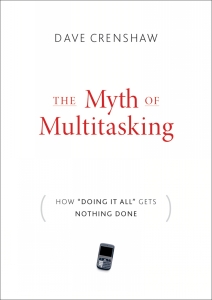
[Review] The Myth of Multitasking

About 20 years ago, I read my first "management fable" style of book. It was the classic Ken Blanchard book, "The One Minute Manager." I wasn't 'wowed' by the book, but I really liked the fable-style presentation. Since then, I've really enjoyed the fable style of business books, and quite a few management fables have made a lasting impression on me (you can see some of them in the "Related items" listing at the end of this review)."Remember this rule: the more responsibility you have, the more hats you wear, the more likely you are to become inefficient."

I'm happy to say that I've just read another book that's going to be a lasting part of my memory: it's Dave Crenshaw's, "The Myth of Multitasking (How 'Doing It All' Gets Nothing Done)".

You're fooling yourself

The core principle of this book really resonated with me: you're fooling yourself when you try to "multitask" activities that require your focus and attention, as this approach introduces inefficiencies that cost you more (both in terms of time and quality) than you realize.

Crenshaw presents a tale of Helen Whitman, a chaotic, frustrated business leader who is working very hard but getting burned out because her business's results are flatlining. Helen's frenetic work style has rubbed off on the rest of the business, creating lots of activity but yielding very little in terms of results.

The coach quickly determines that Helen's problem is her work style (which she thinks of as multitasking) is preventing her from giving adequate attention to important tasks, her family, and her team. The coach explains that multitasking is a myth -- a 'damned lie' to be precise -- and she isn't doing multiple things at once. What she is actually doing is rapidly shifting from one task to another. In the book, this approach is called "switchtasking," and there is a great exercise in the book to show the inefficiency of switchtasking.

What about the times when you feel you can successfully do two things at once? The coach makes a distinction between switchtasking and "background tasking" such as driving while talking on the phone, but he asserts that even with background tasking there is a cost.


What's it costing you?

Using some simple but illuminating exercises, the coach illustrates just how inefficient switchtasking really is and then takes Helen through a process to illustrate just how much this inefficiency is costing in terms of productivity. Through these activities, Helen realizes her sense of time is very distorted and she also becomes painfully aware that her efforts to give people and multiple tasks her attention all at once is creating some extreme dysfunction in her relationships with her family and employees.

Worse, Helen realizes that her bad habits are rubbing off on her team, and trickling down to impact their relationships with customers. Not good. But, as the saying goes, the first step is to admit you have a problem and ask for help -- and Helen does just that.

The rest of the book takes us through the changes (small and large) that Helen makes in her working style which help her defend her time, and strengthen others' trust in her by demonstrating that she is worthy of their trust.

Don't worry - you, too, can have a happy ending

OK, you're probably not surprised that the book has a happy ending, but you may be pleasantly surprised at some of the practical methods it includes to help you gain control of your time, improve your results and achieve a better quality of life.

To augment the story, Crenshaw includes a meaty set of worksheets and exercises in the appendix to help you replicate the same kind of personal discovery and analysis that Helen goes through in the book. It's up to you to apply what you learn, but I found it very helpful to have the tools at hand along with the instructions for how to use them.

This book is a quick and easy read -- the fable portion is about 100 pages long -- but it packs a lot of learning in a short space. I recommend it for anyone who wants to be more productive, but I particularly recommend it for anyone who believes they are a good multitasker. Is that you? If so - remember, it's not called "The Myth of Multitasking" for nothing...


Related items


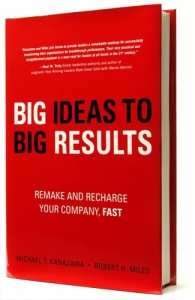
[Review] Big Ideas to Big Results

Many organizations reach a point in their existence when they hit a plateau or begin to stagnate. When that happens, they often seek a "breakthrough" in their performance. Sometimes, they succeed and sometimes they don't.

I recently read "Big Ideas to Big Results," by Michael Kanazawa and Robert Miles, which is all about increasing your chance of success when you're seeking to re-vitalize your company. This book had a unique attraction for me, since I worked with Mike and Bob on one of the transformations they discuss in the book (it was called "Taking Charge" and is referred to at various points throughout the book, but specifically summarized on page 118 & 119).

The authors have worked together on a number of corporate transformations, and they share their experiences to help us minimize the chances that we'll run the "typical" course: some lame, corporate feelgood program that achieves nothing. I've been there and it is not a fun fate.

Beware of zombies

The authors do a nice job of keeping things interesting by telling colorful stories to illustrate their points. One I enjoyed is Michael Kanazawa's discussion of "Zombie Projects" which he encountered, ironically, while working in the same area as Dilbert's creator Scott Adams.

"Zombie projects had supposedly been killed through inattention or lack of formal funding, but, in fact, they continued to live on as pet projects of key manager who couldn't or wouldn't let go."

These kinds of projects suck resources and motivation from the rest of the organization, causing "drag" on the business. The authors discuss the reasons these projects are allowed to exist and most of the book deals with how to ferret out and get rid of these kinds of useless activities.

Set the right drumbeat

Another interesting topic covered in the book deals with how leaders can make or break their team's success through the "drumbeat" they establish. Examples of leaders who to force too much "sense of urgency," which often has the opposite effect; rather than getting people to work harder or faster, their "urgency" shuts down debate and makes people feel anxious or frustrated.

They offer some powerful tips for how to manage your team's "sense of time" so that people use their times productively, without panic, and without feeling like they'll slow down progress by injecting their opinions or challenging things that are happening.

Engage the masses

One of the things that comes out strongly in the book (and one of the most memorable aspects of the Taking Charge project I was part of) is that the authors have developed a true methodology for engaging  people across a company and focusing them on a specific set of outcomes. Their construct called "Tablework" is a big part of encouraging innovative thinking and microcollaboration among small teams, which is then reconnected back into the company's larger objectives.

Perhaps the most powerful aspect of their approach is the drive to create "leaders at all levels" - crucial in creating a self-sustaining, effective business that can scale. A big part of that is letting people throughout the organization own various aspects of strategy and execution - and holding them accountable.

But one other vital aspect of this is making sure people feel recognized for their part in the company's success, and helping them discern the difference between things they must do and things they must strive for. They present the latter using a concept I really love - the distinction between "promises" (absolute goals) and "declarations" (a statement of intent when the means to get there are unknown).

Get big

This book is jam packed with information and techniques, but is fun to read. I also believe it can be a handy recipe book to help managers and leaders deal with specific problem areas, even if you don't go through the whole transformation process form end-to-end.

If you're a leader looking to drive your business out of the "same old same old" then I highly recommend Big Ideas to Big Results.


Related items

Read More

[Updated] Execution Revolution Review

[Update:] When I originally reviewed this book back in April, it was based on my reading of a pre-release copy in PDF form. Recently I received the hard copy and re-read the book. I liked the book even more in its finished form, and have some updated thoughts on it, reflected in the text below. I also realized just how much more I engage with a printed book vs. an on-screen book - no wonder I print out lots of PDF's to read them on the plane...

Gary Harpst's "Execution Revolution" is a book designed to get your business to the next level. I loved this book, and I think the subtitle sums it up quite well: "Solving the one business problem that makes solving all other problems easier." What's the "one problem?" Execution.

Voice of experience

If you're unfamiliar with Gary, he was the founder of Solomon Accounting (very popular software back in the 80's and early 90's when the PC industry was very young). He grew his business from a startup to a large, successful enterprise - finally selling the company to Great Plains Software (since purchased by Microsoft) for a hefty sum.

One of the things I love about Gary's methods and style is that he incorporates his own lessons learned, successes, and experiences into his books - and that makes his guidance seem much more actionable and achievable.

More than a memoir

Don't worry, though - this book is not about hyping up Gary's past. Instead, he presents stories we can learn from (like when he had to layoff half his company) and provides structure and techniques so other small-to-medium businesses (SMB's) can avoid some of the problems he encountered. The other thing I noticed very early in the book is that Gary uses tons of data to support his ideas (but I guess that makes sense from a guy who started an accounting software company).

The stories Harpst relates (his own and specially selected vignettes from other companies) rang true for me - whether he was talking about the problem with communication as an organization grows, the tendency to refrain from action even when you know the right thing to do, or problems that occur when you don't factor human nature into the difficulty of making business changes.

A book of action

This book is centered on a methodology designed to guide you through actionable steps to become better at execution within the business, with the goal of taking your business to the next level. Just as his first book focused on Six Disciplines, Harpst has focused Execution Revolution on a 6-phase system to address problems with execution:

  1. Decide what's important (Strategy)
  2. Set goals that lead (Plan)
  3. Align systems (Organize)
  4. Work the plan (Execute)
  5. Innovate purposefully (Innovate)
  6. Step back (Learn)

And the whole thing repeats.

Knowing vs. doing

Now, at a glance, you might think "OK - that all sounds obvious or familiar..." but I encourage you to see what Harpst has to say. After all, how many business have a pretty good idea what they should be doing, but are falling short on delivery and execution? Harpst has obviously been there along with the rest of us, and has devoted his attention to helping organizations break through this obstacle to become high performers.

Harpst's book goes beyond platitudes, and his recommendations are meaty and actionable.

The Power of Compounding

One notion I really liked is how Gary applied the concept of "compounding interest" to businesses operations and individual actions. He states that "...compounding teaches us our lives are built on our past," and discusses how even small decisions really matter:

"Building an organization that knows how to execute is based on how you do the little things; every goal you set, every interaction with a team member, every person you hire, every customer interaction. They all matter. And they are all compounding for good or for something else."

This whole concept is about building sustainable, thriving businesses - not just opportunistic, "flip this house" kinds of businesses - and Gary does an excellent job of making this point.

This is not a 'getting started' business book. It's a 'getting better' or 'getting results' book that is well-suited for established SMB's who are in the midst of (or in fear of) a plateau or decline in performance. If you want to jump the curve and get better results in leading an SMB, this book is one you should read.

Read More

Cool news roundup

I've been a bit busy lately but, in cleaning up my inbox I found several very cool news updates that I want to share with you:

SameCell is now at Version 2.0!

I've written about SameCell in the past (here and here) and still think it is a very cool app for the Blackberry. It is even cooler with their version 2 (full list of new features on the SameCell web site).

Beyond some nice interface improvements I think my favorite new feature is their new Events feature (example at right), that lets you create new events (and even new event categories) and broadcast them to other SameCell users nearby. You'll notice an intriguing "Speed Trap" event, for example. You can also customize how you broadcast any event to others - including whether you share your contact info, your location, etc.

They've also added some tagging and rating features to you can tag favorite locations, rate restaurants, and things like that. Very nice additions to an already powerful application.

And it's still free. Find out more or sign up at the SameCell site if you're interested. I've already dropped my hints there that I'd love to see an iPhone version, by the way.

Free photo calendar creation tool available

Thanks to Kathy for telling me about a free online tool to create calendar pages with the photo of your choice. You can print any month's calendar with an image you upload on the page size you select. In a few seconds, you have a PDF of that month's calendar that you can print or share. Perfect for hanging at work or around the house.

My kids will have fun with this one! If you want a sample, click here to download an August 2008 calendar page I made. It features the picture I used to create the current Genuine Curiosity banner background (it's one I snapped of a museum in Cannes, by the way).

You'll note there is not advertising or anything else on the calendar - just your stuff. Pretty cool.

Corporate Change Manifesto at ChangeThis!

My friend Mike Kanazawa (author of Big Ideas To Big Results) has published a paper at ChangeThis called, "People Don't Hate Change, They Hate How You're Trying to Change Them." I worked with Mike and a team of others on a corporate transformation at Symantec Corp. back in the 90's and really admire his perspective. This manifesto is no exception. My favorite section is "Do More On Less" - which is a great treatment of the power of focus in a corporate context.

Download Mike's manifesto today - it's great reading. And watch for my review of Mike's book coming soon.

Read More