Genuine Curiosity

Author Dwayne Melancon is always on the lookout for new things to learn. An ecclectic collection of postings on personal productivity, travel, good books, gadgets, leadership & management, and many other things.


Say what you mean

Maybe the political season in the US has perked up my ears about this, but I've been noticing some indirect or less-than-committed responses from people in meetings lately.

Here's how it goes: you put forth an opinion or propose a decision, and someone else gives you a response that makes it sound kind of like they agree, but it just leaves you wanting. In other words, I'm looking for an "I agree," or "Absolutely," -- even a "No way, that's not even close" -- so that I can get to a definitive outcome. Instead, I get something squirrely and only "semi-committal."

Some of the ones that bug me are:

  • "I don't disagree."
    • I've challenged this with, "OK, then - so you agree?" - I often get a "No" in response. This seems to be a way to avoid conflict, but it can mislead people into thinking you agree when you don't yet.
  • "I would agree with you."
    • OK, so do you agree? Or is this yet another conflict avoider? I suppose I should test this one next time I hear it (I've heard it quite a bit, recently).

For a healthy, productive discussion, I think it works better if people stay away from squirrely kinds of statements. Have you run across any others like this?

Here are some clearer alternatives:

  • "I'm not convinced yet - let's discuss it some more."
  • "I'm almost there - if we could solve ____, I think I could support this."

Of course, I recognize that it's sometimes necessary to get a little squirrely. I used to work for a guy that would never give up arguing (not debating - this was arguing) until he felt he'd won. I came up with the statement below, which seemed to work to end the argument. Practice saying this in a positive-sounding tone, and it can get you out of dogmatic, one-sided blah-blah's with folks who won't quit 'til they win.

My stealthy (and very squirrely) statement is:

"Well, I certainly can't fail to disagree with you there! Well done."

Work through the double negatives and see what I'm actually saying. My sympathies if you ever need to use this one to stop a nutty argument.

Read More
What's inside your stone?

I spent some time in Calgary and Pittsburgh this week, which afforded me some good plane time to chew through a new book I just received. Short review: Wow - you should check this one out!

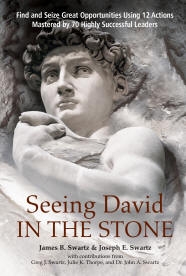
The book is "Seeing David In The Stone," by James B. Swartz and Joseph E. Swartz, and it is about how we can learn to be more effective at unlocking our opportunities and shaping our futures by studying the methods of some of the great geniuses of the past.

I think this is a great companion to Dick Richards' "Is Your Genius At Work?" which I reviewed about a year ago. Dick's book is about how to identify your personal, unique strengths, and this book provides some tremendous techniques to help you apply your genius in different ways to maximize the impact of that genius.

The book's an easy, enjoyable read and is presented as a sort of conversation between a learner and his mentor. It's a captivating story, laced with specific case studies of people like Einstein, Marie Curie, Michelangelo, Edison, Da Vinci, and a 65 other masters of their craft. A lot of the stories are from long-ago history, but you'll be pleased to find some spotlights of recent breakthrough successes, as well.

What's so special about this book?

I occasionally allude to some of the IT process consulting work I'm involved in as part of my 'day job,' but it's been more than just consulting. I've been privileged to be part of a groundbreaking research effort to observe and catalog the best known methods of high-performing IT organizations around the world. This research has led to some revolutionary, prescriptive guidance that enables any IT organization to benefit from the things the high performers have Darwinistically evolved on their own (shorten the learning curve, if you will).

"Seeing David In The Stone" has a similar feel to this IT research, since it catalogs and analyzes the practices of some of the most influential people in history. The book then provides a clear, ordered, 12-step process to help you tap into the best known methods of these highly successful leaders.

The practices are context- and industry-independent, and are well explained in the book. I read the book over the course of two flights this week, and found myself getting energized and excited about applying the principles in the book. Some of the concepts "clicked" so hard for me that I could literally feel the connection in my head.

I highly recommend this book for anyone who's involved in a creative pursuit, or who has the spirit of a learner, entrepreneur, or inventor.

Read More

ParetoMan - 21st century superhero?

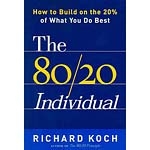
Not long ago, I wrote my post on the value of improving your strengths by only 10% (see "Related items" at the end of this post). What a lovely coincidence that, only a week or so later, I happened upon Richard Koch's book, "The 80/20 Individual".

As you may infer from the title, this book discusses a personal improvement strategy based on the Pareto Principle, better known as "the 80/20 rule." (Koch wrote this book as a follow-up to his 1997 book, "The 80/20 Principle" which I've never read).

I've been pleasantly surprised by the depth, insight, and applicability of this book.

The power of "wealth-creating" individuals and small teams

Overall, this book is about how to maximize the impact of your individual wealth-creating capabilities by exploiting your top 20% most valuable skills, ideas, and activities. Even in large organizations, a lot of the power and growth comes from small teams and their ability to disproportionately exploit the resources of their larger parent. Koch tells us that, when companies enter the Fortune 50, their growth slows down dramatically. In fact, the research he cites found that 91% of companies entering the Fortune 50 never grew substantially again without acquisitions.

His techniques are all centered on creating a growth "engine" to create wealth and achieve wild success.

An energizing presentation

Based on the title, I was expecting this to be focused on individual strength development, and I expected to see a lot of the same kinds of "psyche yourself up" techniques present in many self-improvement book. Instead, I found a holistic approach to help you deal with and maximize individual strengths as they relate to success in business. There are exercises and advice in the book to help you tune your mindset to look for your strengths, as well as case studies to help you maximinze what Koch calls your "20% spike." The 20% spike is the "thing", in any endeavor, that provides unique, game changing differentiation for people who win.

Koch spends some time discussing people like Bill Gates, Warren Buffett, and others to discuss how they've maximized their "20% spike." Anyone who's able to win by maximizing their 20% fall into a group that Koch terms, "80/20 Individuals."

The "meat" of the book is 9 chapters called "The Nine Essentials of 80/20 Success." Each chapter has a philosophy, some examples, and advice to help you apply the nine essentials.

Read More

Is there a hockey stick in your world?

You may have noticed the deafening silence in my posting this week (or not - but it was there). That's because I work for a software company, and it was the end of a quarter.

In our business, the end of every quarter is a frenzied period in which a large portion of our quarterly business closes in just a few days time. This is fairly common within every software company I've ever been associated with, and it can be an exciting and stressful phenomenon.

Exciting, because there are a lot of great, game-saving "plays" that pull a team together to do what it takes to get the business in. Stressful, because it's really hard to predict where your business will come in when so much of it remains "invisible" until the final days of the quarter. The fact that any delay in process on either side (the company's or the customer's) could cause the business to slip beyond the end of the quarter. In these cases, it can affect the software company's profitability or, in the case of many customers, the budget may "disappear" if it isn't spent.

This is called the "Hockey stick effect" in our business, because it means a big spike at the end of the quarter, causing our daily business graphs to be shaped like hockey sticks.

This effect seems to be rooted in the quarterly-focused metrics of the public software company, but it happens in privately held companies, as well (like mine). I often wonder how much customers perpetuate this phenomenon by holding their buying decisions until late in the quarter to gain extra pricing leverage against software companies?

This has gone on so long in our business that I think it's baked into the fabric of the software business.

What about those of you in other businesses? What kinds of cycles do you deal with? Are they good or bad for you, your customers, and the business?

I'd love to hear your stories.

Read More

Do you know what you're talking about?

I've been involved in (and even instigated) a bazillion shapeless, formless conversations in business. You may know the kind I'm talking about - you have a meeting, a bunch of folks show up, you talk for a while, and the meeting breaks up. Did you get what you needed out of the meeting? Nope.

Here are some of the things I've learned (some, the hard way) that can help make these conversations more productive - especially valuable for sales situations, partnering discussions, "buying stuff" meetings, and things like that.

Read More