
Genuine Curiosity

Author Dwayne Melancon is always on the lookout for new things to learn. An ecclectic collection of postings on personal productivity, travel, good books, gadgets, leadership & management, and many other things.


[Review] Ignited!

I've been reading Vince Thompson's awesome book "Ignited!" and I want to share my findings with you. For me, one of the measures of a book is how likely I am to give someone else a copy (at the end of this post, you'll find my list of my "most often given" books). For the first time I can recall, I gave a copy of this book to a friend of mine before I even finished it -- Chapter 2 had my head buzzing.
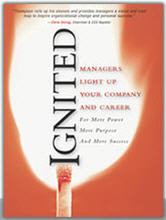
This book is geared toward middle managers, and Vince spends a lot of time on how to improve your ability to "lead in a limited space" (I love that phrase). However, I think anyone working in an organization can learn from it, whether they're managers or not (or in the middle or not).

The book is divided into three parts, each with a distinct focus.

Figure out where the "You are here" dot is on your map

Section 1 focuses on you at a personal level -- figuring out what your opportunities, challenges, and key relationships are. This section does a great job of getting you to analyze where you are in your world, how you interact with others, and how your emotional responses can help or hinder your progress.

In the aforementioned Chapter 2, there's a technique which helps you map out your "universe" of relationships. In this chapter, Vince guides you through mapping your manager's universe, and assessing the quality of your relationships with key stakeholders to help you determine where you can contribute to make a big difference in your manager's success. The idea is that you will make your own life better if you're seen as a contributor to your manager's success. The simple tools and techniques here make this a piece of cake to do, and I think it's extremely powerful. This chapter alone was worth the price of the book for me (and you can apply the same process to your spouse, or other key relationships in your life).

Create value and light up the network

Section 2 is all about creating value for your organization by engaging others and honing your story, strategy, and interpersonal engagements to build your network of influence. In this section you focus on creating value in your organization by improving processes, becoming a better "connector" of people and ideas, figuring out what your market reality looks like, and more. There are also techniques to refine your story and clarify your strategy for driving success. Finally, you "Ignite" others in your organization to help support your activities, goals, etc. and take it to the streets.

My favorite chapter in this section deals with mapping out your landscape and tapping into the expertise of your customers to improve the quality of your "product." This also provides some good ideas for recruiting customers and partners as part of your team as evangelists.

Growing, accelerating, and sustaining

Section 3 discusses how (and why) to sell your story so you dramatically increase your impact and leverage beyond your immediate sphere of influence. This is a short, but meaty, section that discusses how to sell your ideas up the chain (both inside and outside your company), and how to effectively tackle and resolve the inevitable challenges that come up along the way. The discussion of the "right" and "wrong" ways to sell is very good.

My favorite chapter in this section is one on "Your Own Sense of Balance," which helps you understand how personal clarity, focus, and commitment are necessary but not sufficient for success. There is some advice here about leveraging your "personal board of directors," establishing a meaningful set of metrics to track your progress, and keeping yourself sane, safe, and sound so you don't burn yourself out once you've got the fire going.

In summary, I definitely recommend this book - spend a few minutes with it and you'll figure out why it's made its way on to my "most often given" list. Oh - and to find out more about Vince and his book, check out the companion site, BeIgnited (there is also an animated intro from Vince there - I thought it was very cool).


Dwayne's "most often given" books:

  • "Mastery," by George Leonard - a great gift for graduates and people going through big transitions
  • "Managing with Aloha," by Rosa Say - a tremendous book on management philosophy, told in a powerful way
  • "Two Weeks to a Breakthrough," by Lisa Haneberg - the most effective, repeatable process I've found for making blowout progress toward any goal
  • "Is Your Genius At Work?," by Dick Richards - an excellent "workshop style" book to help anyone trying to find their passion / raison d'etre
  • "High Impact Middle Management," by Lisa Haneberg - a very practical (but still very insightful) set of techniques, particularly good for new managers
  • "Ignited!," by Vince Thompson - see review above

By the way - I also give away (or refer people to) quite a few other books including all the ones you see in the left-hand column on my site, but these 6 seem to be the most "prescribed" books in my library.

Read More

Learning to be ‘easy to talk to’

Ok, so you thought I was going to talk about packing, right? That's coming...but first:

This evening, I was spending a few minutes catching up on the blogs to which I subscribe -- which is something I haven't had the cycles to do lately, and it is really good climb back in. One article that grabbed me is Rosa's post on Joyful Jubilant Learning, called "Learning to Talk to Each Other."

You see, Rosa is one of the people that really got me to talk to other people in "blog world" a couple of years ago, and has been a beacon for me for how to get meaningful dialog to happen. Through her blog, appropriately titled "Talking Story," Rosa writes a lot of stuff, and reaches a lot of people. But she also listens, connects dots, and "refactors" things to make them better -- that is her real gift. Some examples I've seen:

The magic happens because Rosa is easy to talk to, and that's because she really listens and shares relevant experiences with people. She gives herself to the conversation in a way that gives you the impression that she's really paying attention, not trying to think about what she's going to say next or what she's going to do after the conversation is over.

Oh - and did I mention that I consider Rosa to be one of my best friends, even though I've never met her face-to-face, and we've only spoken live once? I don't know how she does it, but she has a knack for reaching out to me at just the right time, with something I didn't realize I needed.

One day, I hope to become as good at connecting with people as Rosa.


Related items

Read More

What box are you in?

I recently heard someone say, "You have to see the box to get out of it." Interesting concept - without knowing what's limiting you, how do you know how to overcome it? There are several different approaches I've seen to "naming" and overcoming things that may be limiting you. Here are some that come to mind:

Seek outside help

Often, we can't see our own limitations objectively. This is where coaching comes into play. As I've described here previously, a coach can help you with a totally different perspective, and the advantage of experience that you don't have. A coach can also help you question self-imposed limitations that are inhibiting your success. Need a good coach? lots of them have blogs - start Googling, or ask around.

Use your imagination

One often-underutilized resource is your own imagination. Ask yourself questions like:
  • If I could wave a magic wand, what would help me break through to the next level?
  • If I could have any helpful resource, what would it be?
  • If I had access to the perfect expert to help me solve my problem, who would that be?
  • If I could make one limitation go away, which one would it be?
  • And so on...

Often, these kinds of questions will help you gain better clarity on what's really holding you up, or help you identify where you should go to get past your current limitations. The "magic wand" question, in particular, has helped me get past quite a few stuck spots.

By the way - once you answer one of these, go ask for what you came up with ,or figure out who you can ask to get it!

Find a good "how to" resource

If you have an issue, chances are someone's written about how to solve it (or something similar). Again, Google is a good place to start. Often, I find that blogs, books, and discussion groups have extremely helpful resources to tackle new challenges. And don't forget to ask questions - if the problem stays in your head, you aren't likely to get much helpful advice.

Get clear on what you want

Ambiguity is not your best friend, when it comes to feeling like you're making progress. Often, when I'm dissatisfied with the state of things, I find that it's because I'm not really clear on the outcomes I want. Some resources that can help here include:

Take it day by day

There are lots of resources that provide great tools and techniques to break your goals into bite-sized pieces. My favorite is Lisa Haneberg's "Two Weeks to a Breakthrough: How to Zoom Toward Your Goal in 14 Days or Less" since it gives you daily assignments to help you move toward any specific goal. This is kind of like having a coach in a book. I gave my wife a copy, and she said, "This is great - at some level, I already new a lot of the things in here, but having a daily assignment keeps me from feeling overwhelmed - and there are some new tricks in here, too."

Share

Share your goals with others. Share your frustrations with others. Share your success with others. Share your experience with others. All of these things can help you get out of the box your in, or help others get out of their boxes. Feeling stuck? Don't go it alone - use the resources at your disposal.

Remember: You are responsible for your own well-being.

Got any stories, resources, or breakthroughs? Please share them!


Related items:

Read More

Management by marching around

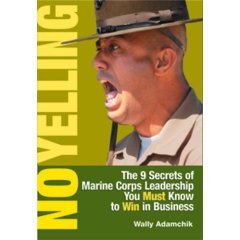
When I first heard about the book "No Yelling: The 9 Secrets of Marine Corps Leadership You Must Know to Win in Business," by Wally Adamchik, I was intrigued. I've never been in the military (though my father and grandfather were). As such, I don't have any real-life context for what their management style is like. However, I've worked with some awesome people who had tremendous business and organizational skills that they picked up in the military, and I wanted to see if this book would be useful to me in my work.

Let me start with this: Wow - am I glad I decided to read this book!

This book takes 9 core principles of management and gives each of them a chapter. The topics are:

  • Integrity
  • Technical Competence
  • Set the Example
  • Self-Awareness
  • Take Care of People
  • Make New Leaders
  • Commander's Intent
  • Culture and Values
  • Rehearsals and Critiques

This book is not preachy, dry, or mechanical. It is not rigid and robotic. This is a tremendous collection of object lessons to convey the essence of each of the 9 topics, and provide vivid examples of what these principles look like when they are applied effectively. There are also some great stories that illustrate the risks of operating in conflict with these principles.

Adamchik does a masterful job of framing each of the topics, and weaves his collection of anecdotes together with insightful commentary on why they are essential, why they are effective, and how things fall apart in their absence. You also get a clear example of how communicating trust, practicing effective delegation, and other practical skills can accelerate the development of a team.

Full spectrum storytelling

Inside this book, I found a full spectrum of stories - funny ones (such as one that occurs when he gives a vague instruction like, "Go do something productive." - and hilarity ensues), serious ones (such as one in which a commander takes full responsibility for a mistake made by junior members of his unit), humbling ones (as in stories that show the power of "being a part of the team" as a manager), and much more.

I also came away with some areas where I felt compelled to do better in the future than I've done in the past. What more can you ask for in a book?

Pick up a copy and you'll see "Semper Fi" in a whole new light - and you'll probably pick up some insights that will help you grow as a leader.


Related items

Read More

Leadership made simple?

No, I don't profess to have a magic answer to this problem. However, I've just finished reading a book with a view on this. It's "Leadership Made Simple," by Ed Oakley and Doug Krug and it has some practical insights to help deal with some challenging topics for leaders.

They present a well-organized, concise "Framework for Leadership" (apparently they've trademarked this term), which provides techniques, guidance, and examples to help improve team performance. This book is a quick, engaging read and could be very valuable, particularly if you have team dynamics issues you're dealing with. I also feel this book could be a good add to the library of a new manager / aspiring leader.

This book provides a nice blend of philosophical guidance, coupled with some specific techniques for working through organizational alignment / organizational change management quandaries.

There are some great examples in the book that underscore what I like to think of as "management curiosity" - seeking to understand and learn from each situation the team works through. You'll find some excellent things for your toolbox in the section on Effective Questions, and a discussion of the relationship between good questions and the quality of the answers you receive.

Along the same lines, I found the "Questions To Think About" topics at the end of the major sessions particularly insightful, and the anecdotes in this book were very well constructed.

A difference of opinion

In fact, one of these anecdotes brought out an issue where my opinion differs a bit from the authors'. In the book, there is a discussion about the value of "Focusing Forward" to drive success in the future.

"Joy does not occur when we focus on what's not working - on our mistakes and failures. Instead, we facilitate joy in the workplace when we focus forward - on what is working, the successes we have already achieved."

OK, so I don't totally disagree with this notion, but I feel you lose a lot of learning if you ignore your mistakes and failures. It's like a mentor of mine once pointed out to me:

A lot of sports teams find huge value in reviewing tapes of past games to identify areas where they made mistakes, and trying to consciously understand why they made those mistakes in the past.

If you approach your mistakes and failures with a spirit of learning and growth, you'll get a lot more out of life than if you just ignore them.

In any case, I enjoyed this book and will hang on to it and refer back to it for some good tools.


Other titles to consider

  • If you're in the market for a more "how to" guide, I recommend you also pick up a copy of Lisa Haneberg's "High Impact Middle Management."
  • Another excellent book on achieving organizational alignment is "Execution," by Larry Bossidy and Ram Charan.
  • Finally, if you want to get into the zen of leadership, pick up my favorite "why to" book, "Managing with Aloha," by Rosa Say.
Read More