
Related Posts Plugin for WordPress, Blogger...

Genuine Curiosity

Author Dwayne Melancon is always on the lookout for new things to learn. An ecclectic collection of postings on personal productivity, travel, good books, gadgets, leadership & management, and many other things.


Ho‘omau: Cause the good to last

I just finished reading "Mastery: The Keys to Success and Long-Term Fulfillment" by George Leonard, as recommended by Bren. This one now goes on my "permanent record" of books to recommend to others (in fact, I bought another copy on the way home last night and gave it to a friend of mine today to help him on his personal quest).

True Masters learn to savor the plateaus because they understand that they are building character and feeding dormant skills that will blossom later.The essence of this book: On the road to Mastery, there are many plateaus where you may become frustrated because you aren't getting any better. True Masters learn to savor the plateaus because they understand that they are building character and feeding dormant skills that will blossom later.

At some point, all the practice pays off and you achieve the next level on your journey toward Mastery. Of course, then next day the Master goes back to practice and begins crossing the next plateau. That's the other thing the Master understands - the journey never ends.

Masters embrace the plateaus, while normal people get sick and tired of practicing without visible results, and often abandon their pursuit.

The other thing that non-Masters often do is choose to accept the status quo and stop improving. Why? Because you typically have to get worse before you can become better. One example Leonard gives is golf:

"If you approached most golfers who consistently score in the 90's, and told them you could help them score in the 80's, they'd be interested. However, if you told the same golfers that the steps they'd need to take would cause their score to go over 100 for the next 12-18 months, most would choose to stay where they were. The Masters would take you up on the offer."

Don't feel like a master? Don't worry - nobody is a master of all things, but most of us have the power to become masters in at least one area of life. For example, you may be a novice in athletics, but a Master facilitator. And I know sometimes I have trouble figuring out whether I'm in a plateau, or if I've picked an area where I'm just not cut out for mastery. How do you tell the difference? That's the challenge.

Find your passion, and ride the wave.

And check out Mastery - see if it makes it to your "permanent record."

Read More

Got stamps?

For those of you in the US, use your 37 cent stamps by Saturday so you don't have to hassle with those 2-cent auxillary stamps. The standard postal rate in the US goes up to 39 cents on the 8th of January.

Read More

My favorite books from 2005

A bit slow on posting this week, since I screwed up my back over the weekend and it's been hard to simultaneously a) lie on my back on the floor, while b) doing anything on the computer.

However, I would like to take a few moments to recap the 5 favorite "self development" books I read in 2005.
  • Managing with Aloha, by Rosa Say.
    • As I mentioned in my review earlier this year, this is a "why to" book much more than a "how to" book. It is about managing with values and principles, and is loaded with very poignant stories and words to live by. As I read the book, I was also fortunate enough to become a part of Rosa's "Talking Story" blog and her "Ho'ohana" community.

      Along the way, I've met lots of very interesting, genuine people through this process and made some great friends. For me, the magic extends far beyond the book. Read the book, visit the blog, and see if you find the same happens for you.
  • Mastery, by George Leonard.
    • This is one of my most-often recommended, and most frequently "given" books (I've given tons of copies away to friends). It is great for people making transitions (or trying to) such as graduates. As I summarized it in my review:
      "The essence of this book: On the road to Mastery, there are many plateaus where you may become frustrated because you aren't getting any better. True masters learn to savor the plateaus because they understand that they are building character and feeding dormant skills that will blossom later."
  • Is Your Genius At Work?, by Dick Richards.
    • I love books that take you on a worthwhile journey. Dick's book is one of those. It's a guided tour to find your Genius. In my review, I described "genius" as: "that special capability that you have that makes you special, and flavors all the other parts of who you are and how you interact with the world." Isn't that worth discovering? I think so.
  • High-Impact Middle Management, by Lisa Haneberg.
    • As I assembled this list, I realized I hadn't really reviewed Lisa's book. I could've sworn I did, since I've mentioned it so often this year. As you may recall, I participated in Lisa's "2 Weeks 2 A Breakthrough" pilot earlier this year, which I found out about through her excellent blog Management Craft, which led me to this excellent book. The book, which is often called "H.I.M.M." for short, is an excellent toolkit to help you become a more effective middle manager. It combines solid theory, lucid examples, and practical tools to help you manage yourself and your team more effectively. It's ideal for anyone who manages.
  • Beyond Bullet Points, by Cliff Atkinson.
    • This book transformed how I do presentations. In the first review, I cover the essence of the book, the Beyond Bullet Points process, and describe my first results using this technique. In the second review, I describe my experiences with Netcentrics' powerful Beyond Bullet Points PowerPoint Add-In. Check them out if you do presentations.

Honorable Mentions:

Consciously Not On The List

By the way, before you ask - there is nothing from Covey or David Allen on the list because I read them all before 2005 started. Also, I'm in the midst of a few other good ones to give 2006 a great start.

Read More

Here's to you, Mr. Rogers

"Of course, I get angry. Of course, I get sad. I have a full range of emotions. I also have a whole smorgasbord of ways of dealing with my feelings. That is what we should give children. Give them ... ways to express their rage without hurting themselves or somebody else. That's what the world needs."

--Fred Rogers

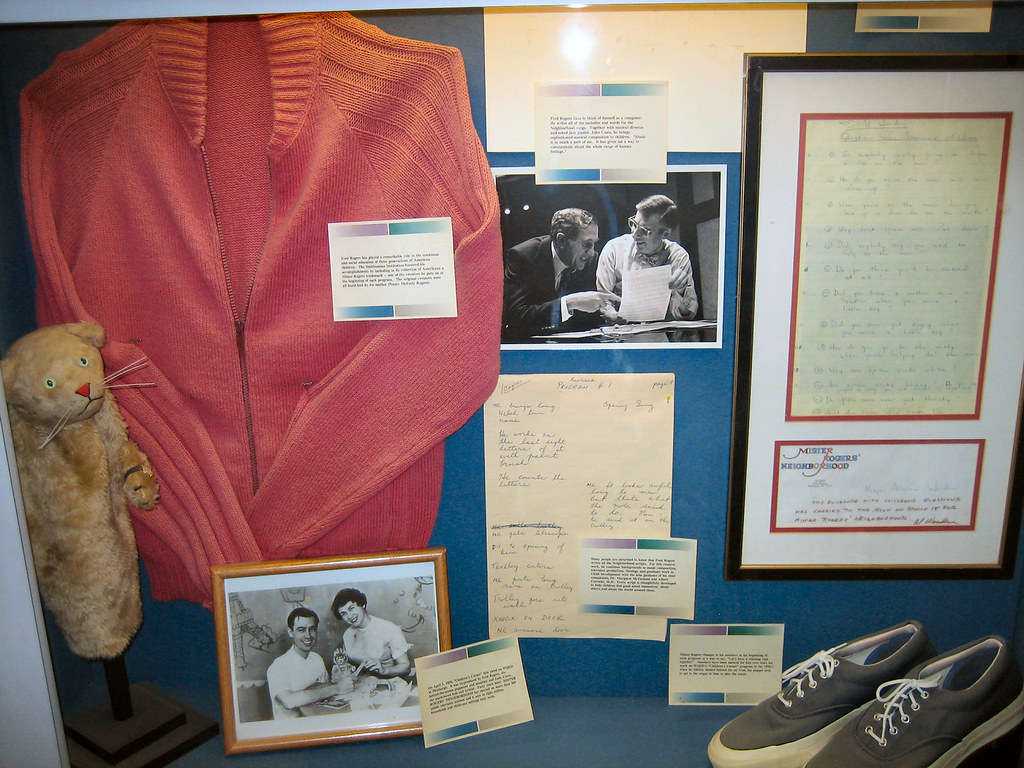
I spent a bit of time in Pittsburgh the other day. While I was waiting for a flight, I wandered past a display celebrating the life and works of Fred Rogers (1923-2003). I just had to take a picture.

For any of you who grew up watching Mr. Rogers' Neighborhood, you know that he was no ordinary guy.

I remember how much I looked forward to seeing Mr. Rogers once I discovered his show. I watched every chance I got - my favorite thing was seeing the Trolley that took us to the Kingdom of Make Believe. I've always been a fan of trains, and that Trolley was so cool.

I remember Mr. Rogers' songs, and can still sing a lot of them from memory. I remember the tours he used to take the audience on, to show us how things were made - and how different people did different things in different parts of the world.

When he introduced us to his friends around the neighborhood, they seemed like my friends, too. I always wanted to go visit that neighborhood for real.

What I remember most of all is the consistent message he sent: We're all different, and that's OK because we each bring a unique value and perspective to the world. He seemed to maintain a child-like innocence throughout his life, and spread tremendous energy in a way that mattered somehow. Not just in the big things, but in the small things, too.

We need more people like Mr. Rogers.

Read More
Copyright 2005-2015 Dwayne A. Melancon, all rights reserved. Licensed under Creative Commons - see the "About the Author" page for details.