Genuine Curiosity

Author Dwayne Melancon is always on the lookout for new things to learn. An ecclectic collection of postings on personal productivity, travel, good books, gadgets, leadership & management, and many other things.


Interesting Finds (oS edition) 2006/04/26

If you've spent much time on David Allen's "Getting Things Done," you know that the goal is to get everything out of your head by putting all your projects, tasks, etc. on lists. Then, you look at the lists, get them to next actions, and renegotiate your internal commitments so that you don't feel guilty, overwhelmed, or otherwise at the mercy of all the stuff on your list. It's easy - put all the things you don't want to do or think about on a "Someday Maybe" list.

The theory behind "Getting Things Done" is that your subconscious will know about this renegotiation and leave you alone about the things you haven't done. That's cool and everything, and I've found it to be a very effective technique. But I think it only works perfectly if all the people around you have the same "Someday Maybe" list that you do. I live in a house with four other family members, and I generally can't get universal agreement on anything, so this sometimes creates challenges.

I've been experimenting with a new way of dealing with this that seems to be working. Here's a story about it:

I've created a new project on my Projects list called "Reduce clutter and get rid of stuff we don't use any more." That is a vague, overwhelming kind of project that I could just leave on a "Someday Maybe" list forever. The challenge with it is, a) it's something I want to do, b) it's hard to know where to start, c) there is no shared sense of urgency around this project, and d) "done" means something different to everyone in the family.

To make progress against this, I have been working with my kids on a periodic "mini-project" called, "Pick one box o' mystery and process it." Processing means:

  • tossing out anything that's trash, broken or unusable,
  • putting misplaced things where they belong,
  • getting rid of stuff we never should've kept in the first place (how many Happy Meal toys do we really need?)
  • sorting and finding a permanent home for anything that looks remotely like a collection,
  • putting anything that's still usable into our 'giveaway box' so we can donate it,
  • etc.

This can apply to any container, drawer, closet, or other vortex of accumulation around the house. At first, it was kind of a pain, but now 2/3 of my kids look forward to it and ask me when we're going to process another box. We do a few a week, and it give us enough progress to feel good about it without feeling like it's eating up all our fun time.

I think this model can apply to lots of ongoing projects with vague "completion" criteria, and have been brainstorming how I can apply this to some of the other parts of my life.

What about you - have you developed any tricks to make the daunting tasks in your life less daunting?


Read More

Interesting Finds

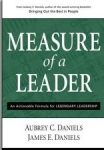
"It's about results, not activity." ...I used to think that was a good code to live by but, at some level, it kinda bugged me."It's about results, not activity." This is a phrase I hear quite often -- in fact, it's a favorite mantra of many leaders I admire. I used to think that was a good code to live by but, at some level, it kinda bugged me. Thanks to "Measure of a Leader" by Aubrey C. Daniels and James E. Daniels, I know the truth.

I've been waiting for a long flight so I could read this book, and got my chance last week on a trip to New York last week. According to the foreword, this book is the culmination of about 30 years of learning and experience, and I found it to be an insightful look at leadership techniques and measurement. The philosophy is similar to that of "servant leadership" that is all the rage. Consider one of the major models presented in the book:

"You are a leader only if you have followers. While this seems obvious, its implications are not. It suggests that the focus of any study of leadership should be on the relationship between the leader and the followers, not just on the leader..."

"Our model posits four criteria of the followers' behavior that define leadership:

  1. Followers deliver discretionary behavior directed toward the leaders goals;
  2. Followers make sacrifices for the leader's cause;
  3. Followers tend to reinforce or correct others so that they also conform to the leader's teachings and example;
  4. Followers set guidelines for their own personal behavior based on their perceived estimate of that which the leader would approve or disapprove."

The book goes into a lot of detail about each of these areas, then goes on to provide specific techniques to increase your ability as a leader by setting the right example, evangelizing your vision, creating organizational norms that reinforce the behaviors that drive toward your goals, etc.

By now you may be saying, "Yeah -- whatever. That sounds like about half the management books I've ever read." Well, I'm happy to report there's a lot of new stuff to be found here. For example, there are some excellent techniques to measure and track your leadership effectiveness, and provide a basis for improvement. There's also a rich collection of advice to help creat more meaning and connection in your followers' work.

But what really brings it together are the examples and stories illustrating the principles and techniques. This approach not only makes this book a fun read (it could easily have been as boring as a stock prospectus), it helped me envision how I could personally apply these to my own life.

There is a great discussion about the leader-to-follower impact when you reward for the right kinds of activity, even if they don't yield "results" (though one could argue that organizational and individual learning are a type of result).

Net, net? Leaders get results by inspiring the right kind of activity in their followers. In other words: It's about results and activity.

If you're in a leadership position, and want to improve the state of your art, check this one out.


Related posts:

Read More

Neat Tip: Keeping Your Goals In Focus

When I sit down to plan my week, there are usually several "top focus" areas or items that serve as anchors. Recently, I began adding these areas to my desktop so I'd see them each time my computer booted up, to remind me of my top goals. A friend of mine was intrigued by the technique so I thought I'd share it here, in case it's useful to others.

The concept is simple. First, I create a self-contained web page using Microsoft Word. Then I use Windows XP's active desktop functionality to display the contents of the file. The result is that I always have visibility into my focus areas or goals because they appear right there in front of me on my desktop.

I find that this serves as a gentle reminder of what I intended to get done during a given week, and has served me well.

If you'd like to find out how to do this on your own, then read on.

Read More

It just grabs you and won't let go

Drcutout_2Hats off to Dick Richards (that's him over there on the right) -- his book "Is Your Genius At Work?" is a finalist in ForeWord Magazine's Book of the Year Awards!  (details)

This week, I had lunch with Bren and we both agreed that this book is one of those that grabs you someplace deep in your soul/psyche/heart/head and won't let go.  As I mentioned when I reviewed this under the topic "A Quest for Genius" last year, I've had a tough time distilling my Genius down to it's essence.  This has been - simultaneously - the most rewarding, maddening, intriguing, elusive process I can recall.  If you haven't read the book, you should - it'll help you discover so much about yourself.

Congratulations, Dick - you deserve the Gold when they award it in May!  (By the way, sometimes I think my Genius must be "Chasing Genius")

Read More