Genuine Curiosity

Author Dwayne Melancon is always on the lookout for new things to learn. An ecclectic collection of postings on personal productivity, travel, good books, gadgets, leadership & management, and many other things.


What’s your monorail?

As I mentioned previously, I was in Seattle a couple of weeks ago with my family to do some sight seeing. When looking into local attractions, we'd heard about Seattle's Monorail and decided to find out more about it. However, the monorail wasn't open -- and, as we discovered, it never will be.

This was a grand idea when it began, but it became very controversial due to issues with cost, ongoing funding, and other issues. Many objections were raised, debated, and more. But the decision was made to move forward and begin building the monorail anyway.

Along the way, the funding situation got worse, and things stalled. The city of Seattle withdrew its support for the monorail system and, while they couldn't stop the project, they made it impossible to continue by refusing to make municipal land available to the monorail project.. As a result, the project was left with only a plan for the "Green Line" which never really got off the ground. Ironically, this reminds me of the Simpsons episode, "Marge vs. the Monorail."

It's easy to make jokes about things like this, but I think most of us have "monorail projects" in our lives:

  • Projects that sounded great at the start, but never got completed
  • Projects that ended up "costing" more than you intended and, therefore, became unsupportable
  • Projects that required cooperation from others that never materialized

I've got plenty of examples of these in my life, for sure. But what do you do about these projects? While we can learn a lot from the failure of the Seattle Monorail project, I think they also provide a good example of how to wind things down. Their project site now shows that they are now in the process of an orderly shutdown - something I'm not always good at when my projects fail.

What about you -- any monorails in your life? What have you learned from them?

By the way - the picture above is not a picture of the doomed Seattle monorail project - it's actually of a section of the Seattle Center Monorail, built in 1962 for the Seattle World's Fair. Even though this monorail was closed for repairs when we visited, it is supposed to open again in the future.


Read More
Related Posts Plugin for WordPress, Blogger...

The Effect of a Leader, Starbucks style

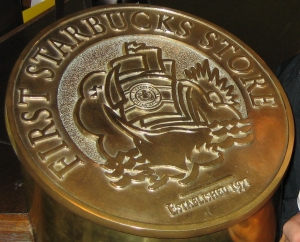
Last weekend, my family and I spent the weekend in Seattle for my son's birthday, and one of the main things he wanted to do was have coffee in the first Starbucks (we are "coffee people" - a combination of our Cajun heritage and Pacific Northwest residency, I think).

The first Starbucks is located in Pike's Place Market along the Seattle waterfront, and the store was opened in 1971. When we walked in, I was struck by the fact that it really doesn't "feel" like the Starbucks I know and love. Sure, there are similarities, but this "version 1.0" of Starbucks has a different ambience. For example, there are no comfy couches (not really any place to sit, for that matter), and it's a lot darker (both in lighting and décor). The similarities? The menu is the same, and all that Starbucks gear you can buy (mugs, coffee makers, etc.)

What was intriguing to me is was how much the "zen" of Starbucks has changed since 1971, and how much it hasn't.

What's the same?

  • The friendliness of the baristas, the terminology, and the excellent coffee are just like any Starbucks I've visited just about anywhere in the world.

What's different?

  • Starbucks v1.0 doesn't feel like the "lifestyle store" you commonly associate with the Starbucks name. It's not as warm, welcoming, or inviting and doesn't feel like quite so much like someplace you'd go to hang out with your friends.

And yet -- this is the place it all started.

What can we learn from this?

In addition to the Venti Sugar-free Vanilla Latte I bought, here is what I took away from the experience:

  • Focus - stay true to your core
    • I love that Starbucks has kept true to their roots of coffee, tea, and spices as the center of their business. No matter how they change, it's still about the coffee, tea, and spices.
  • Re-invent
    • There is a binder in the first Starbucks that shows some of the changes over the last 35 years (yes - Starbucks has been around for 35 years!) and they've not been shy about re-inventing themselves.
  • Innovate
    • Starbucks clearly has the passion to continue innovating around a tiny set of ingredients. Who'd have thought there would be so many ways to dress up a cup of coffee?
  • Evolve
    • Starbucks took the core attraction of its business and has continued to evolve and extend itself to connect emotions and intrinsic value with its core products.
  • Involve
    • From coffee products for the home, to music, and now movies and crossword puzzles, Starbucks is increasingly reaching beyond its walls and creating a sense of community.

Lessons for life, business, and global domination. All from a cup of coffee.

Read More

Out of sight - out of your mind?

I have been working on a wide variety of projects lately, and keeping track of the details and status of them all has been a bit nerve-wracking. Putting them on project lists helped a lot with what to do, but I still found myself searching for status information such as:

  • What have I done on this already?
  • Who am I waiting to hear back from?
  • What's left to do?
  • What's in process but not complete?
  • etc.

Managing this with context lists in the "GTD way" wasn't quite cutting it for me (or maybe I'm doing it wrong). I found myself going to multiple lists very frequently to try to get a holistic picture of where each of my projects stood. To solve this, I turned to my old pal Mind Manager to help me create a "status map."

My "real" status map has too much work-related information that I can't share publicly, so I have mocked up an example of one here. For each project, I map out things such as:

  • Desired outcomes
  • Research
  • Next actions
  • Other
  • Completed actions
  • Waiting for
  • Calls to make
  • To be done

You can (obviously) customize this in any way you'd like. I find that I can keep multiple projects current on my status map (I currently have 4 major "domains" of activity on my map - 3 for work, 1 for home). When I have status meetings, I can print a particular "branch" of the map if the status meeting is about a particular project, or I can print the whole map (I use 11" x 17" paper for better readability). I print the whole map (with the "Home" branch collapsed) when I go into one-on-one meetings with my boss, so I can take him through what I'm working on and where things stand.

As we go through the project review, I write on the printed copy of the map and re-integrate my notes back into my Mind Map later.

This is working pretty well for me, and makes it a bit easier to keep the plates spinning without letting any of them drop.

Here is another mocked-up section of a project to give you an idea the kinds of things that might be in some of the buckets (you can click to zoom in).

If you want to see a blurry, unreadable, zoomed out picture of my real map you can see it here, just for grins.


Read More

Interesting Finds (oS edition) 2006/04/28

If you're into self-improvement, you should definitely check out John Richardson's new project. It's called "MBA On The Run" and it is a cool recipe for simultaneous mental and physical improvement.

What's it all about? It's about getting an MBA-like education by listening to powerful business books in audio format, combined with another activity. In John's case, that's running, hence the "MBA On The Run" name - you can substitute other activities in place of running if that doesn't work for you. With my travel schedule, mine's more likely to be hacked into an "MBA On The Fly" program, for example.

The core:

  • John will be listening to a series of management- and business-oriented audio books on his iPod over a period of time
  • He'll provide the list as it unfolds, write up a book review when each is done, and provide other links that can be useful for one pursuing an "MBAor" (or whatever you want to call it).

You can find out about how various points of light converged to create this vision in John's mind, here.

Read More

Interesting Finds (oS edition) 2006/04/26

If you've spent much time on David Allen's "Getting Things Done," you know that the goal is to get everything out of your head by putting all your projects, tasks, etc. on lists. Then, you look at the lists, get them to next actions, and renegotiate your internal commitments so that you don't feel guilty, overwhelmed, or otherwise at the mercy of all the stuff on your list. It's easy - put all the things you don't want to do or think about on a "Someday Maybe" list.

The theory behind "Getting Things Done" is that your subconscious will know about this renegotiation and leave you alone about the things you haven't done. That's cool and everything, and I've found it to be a very effective technique. But I think it only works perfectly if all the people around you have the same "Someday Maybe" list that you do. I live in a house with four other family members, and I generally can't get universal agreement on anything, so this sometimes creates challenges.

I've been experimenting with a new way of dealing with this that seems to be working. Here's a story about it:

I've created a new project on my Projects list called "Reduce clutter and get rid of stuff we don't use any more." That is a vague, overwhelming kind of project that I could just leave on a "Someday Maybe" list forever. The challenge with it is, a) it's something I want to do, b) it's hard to know where to start, c) there is no shared sense of urgency around this project, and d) "done" means something different to everyone in the family.

To make progress against this, I have been working with my kids on a periodic "mini-project" called, "Pick one box o' mystery and process it." Processing means:

  • tossing out anything that's trash, broken or unusable,
  • putting misplaced things where they belong,
  • getting rid of stuff we never should've kept in the first place (how many Happy Meal toys do we really need?)
  • sorting and finding a permanent home for anything that looks remotely like a collection,
  • putting anything that's still usable into our 'giveaway box' so we can donate it,
  • etc.

This can apply to any container, drawer, closet, or other vortex of accumulation around the house. At first, it was kind of a pain, but now 2/3 of my kids look forward to it and ask me when we're going to process another box. We do a few a week, and it give us enough progress to feel good about it without feeling like it's eating up all our fun time.

I think this model can apply to lots of ongoing projects with vague "completion" criteria, and have been brainstorming how I can apply this to some of the other parts of my life.

What about you - have you developed any tricks to make the daunting tasks in your life less daunting?


Read More