Genuine Curiosity

Author Dwayne Melancon is always on the lookout for new things to learn. An ecclectic collection of postings on personal productivity, travel, good books, gadgets, leadership & management, and many other things.


More tools before you fly

In the past, I've shared some of my tried & true tools for travel - here's a partial list:

Today, I'd like to share another resource: Flightstats.com

I found out about this from my colleague Tom, who turned me on to it when I told him about Seatguru. Some of the useful things you can do with Flightstats - all from one place with no hunting - include:

  • See the latest government air security bulletins
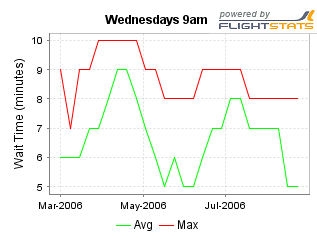
  • Find out what the typical security wait times are for your airport, by time of day (in graphical form, as shown here, also in a table by airline / concourse, with hourly detail)
  • Find out the historical on-time ratings for your flights (and even compare the on-time performance of flights you're considering)
  • Find out about airline mileage club promotions and other "specials"
  • Forums to share experiences with other fliers
  • And a lot more

They even offer an "All In One Widget" that lets you check flight status, view flight performance, sign up for notifications, and view current airport delays within the United States - right there on your desktop.

You need to register to get all the features, but it's free and their privacy policy is good.

Check it out - and make travel a bit more bearable.

Read More

In sanity: Tips for inbox sanity

If you're a "Getting Things Done" follower, you know the value of fewer "inboxes" to process. Reducing the number of places you have to look for information as inputs into your life, the better.

Here are a few tips I've picked up along the way to help reduce the number of nesting places for inputs.

  1. When someone asks you to do or consider something, ask them to send you an email about it. Just say, "That's interesting - can you send me an email about that? Otherwise, I'll just forget it." This technique:
    • puts the burden back on the requester
    • puts the information into an inbox you're already planning to process (your email inbox) which makes it easier for you to delegate it, etc.
    • can sometimes cause things to go away - if they don't feel attached enough to it to send you an email, you're off the hook
  2. Send yourself an email about it. If, like me, you carry a PDA and you have an idea, a thought, something you want to remind yourself about later, etc. just drop yourself an email about it. This technique:
    • puts the information into an inbox you're already planning to process
    • provides a quick way to capture a fleeting thought in a way that allows you to better define it later (if I enter things directly into a task list from my PDA, I'm more likely to leave it in a vague form that never gets acted upon)
  3. Send yourself a voice mail about it. When you're driving, call one of the voicemail boxes that you process regularly and leave a quick voice mail about it. Then, when you process the voice mail, you can drop it into your trusted system. This technique
    • puts the information into an inbox you're already planning to process
    • provides a quick way to capture a fleeting thought in a way that allows you to better define it later
    • doesn't require writing or typing

Do you have any additional tips you've learned that make your journey toward mastery any easier? I'd love to hear what you've learned.


Related posts

    Read More

    Phil's 10 Step Program

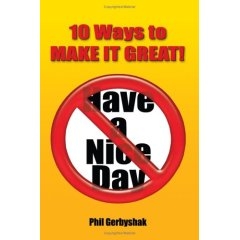
    A couple of weeks ago, I received my official copy of Phil Gerbyshak's book "10 Ways to Make it Great!" I read it almost immediately, and I'm finally staking out enough time to write a review.

    For any of you who've encountered Phil, you'll remember it - he is a high energy, positive, and encouraging guy. I've often wondered, "Where can I get some of what Phil's been eating?"

    Well, in this book, Phil's bottled up some of that energy and relates some of the techniques he collected, developed, and perfected to move beyond a "nice day" world into a "great day" meme. This is a small, carry-it-with-you kind of book and it contains 10 short exercises (mini-workshops is a good way to describe them) to help you make 10 concrete, significant changes to your life.

    Each of these changes is architected to drive a positive result in your life, relationships, and results. They also push for some healthy introspection to help you achieve better clarity of vision to focus your improvement. A lot of these techniques are similar to ones I've encountered along my journey of curiosity. Phil not only brings them all together in a very portable form, he adds his own unique perspective for a new angle on many of the themes.

    For example, we've all heard about the power of envisioning your desired outcomes. In chapter 7, "Dream Big Dreams, Do Big Things," Phil describes how to create a "dream room" to help you create a space where you go to dream. This provides a handy way to condition your mind to get ready to create new ideas, because you have a way to "suit up" for dreaming big. Pretty cool.

    As someone who tends to try to solve problems on my own, I've been trying to develop a new habit of asking for help sooner when I get stuck. Chapter 5, "Surround Yourself With Those Who Can Help You," gave me some new action steps that should help make my journey easier.

    Pick up a copy of Phil's book and carry it with you (it's under 70 pages). Then, when you find yourself having anything less than a Great Day, pull out your essence of Phil and get to work!

    Read More