
Genuine Curiosity

Author Dwayne Melancon is always on the lookout for new things to learn. An ecclectic collection of postings on personal productivity, travel, good books, gadgets, leadership & management, and many other things.


[Review] The Art of Managing

I've just read Jane Treber Macken's, "The Art of Managing: How to Build a Better Workplace and Relationships," and I quite enjoyed it. The beginning of the book felt a bit academic, sharing a lot about the history of management theory, and an overview of various management models and techniques used in the last 150 or so years. But don't let the clinical introduction turn you away - once the book gets going, the author adds a lot of interesting tools and engaging examples that make this a very good read.
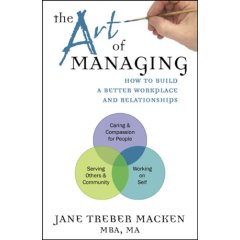
The book is short - only about 100 pages - but it covers a lot of ground in a very effective fashion. Macken does a wonderful job of weaving in material from noted management experts, along with her own personal stories of life and management. She also presents some useful tools and mental models to help you become a more effective manager.

Managing by sitcom

A lot of the fun in this book comes from the way Macken livens things up with things you don't always seen in management books. For example, one model I liked exploring describes office relationship styles in terms of characters from the "I Love Lucy" and "Leave It To Beaver" television shows. I'm a cross between "Ethel" and "Ward," trying to become more consistently "Ward."

I was a huge fan of these shows, so it was a fun exercise for me (and, even if you know nothing about those television shows, Macken describes how to use the model to apply it within your own context).

A plethora of tools

Other models and tools she discusses with her own spin include the Myers-Briggs Type Indicator model, group development and conflict resolution techniques, motivational techniques, and a model for situational leadership.

Finally, she rounds it out with a great set of tools to assess the effectiveness and alignment of an organization, and discusses methods to address any weaknesses or mis-alignment you may discover.

In summary, I liked this book because it gave me some new twists on some familiar management models, as well as teaching me some new tools and techniques I can apply to become a better manager. I believe it would be equally useful to new managers and seasoned veterans.

Read More

pzizz: State of the art power napping

I recently discovered a fascinating tool called "pzizz" and am really enjoying it. Developed by Brainwave Enterprises Ltd., pzizz is software (Windows or Mac) that generates "soundtracks" to help you sleep or take a power nap to re-energize yourself in the middle of the day. pzizz applies techniques learned from scientific sleep research, and creates special sounds that enable you to relax while stimulating your brain at a subconscious level, stimulating your brain waves in a way that energizes you.

Rev up or calm down - it's your choice

The pzizz software enables you to generate customized nap soundtracks of a length you specify. There are two "modules" available for pzizz:

  • Energizer Nap - generates a nap soundtrack designed to help you take the ultimate power nap (you can program it for as long as you want - they recommend you take 20-40 minute power naps for greatest effect. Each Energizer map ends with an "alarm" sound to wake you up so you can continue your day.
  • Sleep Nap - generates a nap soundtrack designed to help you get to sleep and achieve a restful, deep sleep. Sleep naps fade out at the end so you stay asleep.

The software can play the nap files directly on your computer, or you can play them using iTunes or on your mp3 player. If you're playing them on your computer, you can tell the software to automatically shut down your computer or put it to sleep (or do nothing, if you prefer). Each time you generate a nap, it creates a new soundtrack so you don't get bored.

What an experience!

Using a pzizz nap soundtrack is a very interesting experience, and I initially did it just to see what would happen (you can download sample mp3's of the "energizer" and "sleep" modules from the pzizz site). I tried it with one of the "Energizer" naps and found it to be very relaxing and every bit as energizing as they say.

The soundtracks are calming combinations of soothing sounds and music. Additionally, you can turn on an option that tells pzizz to add in some encouraging messages using Neuro Linguistic Programming (also known as NLP, or the power of suggestion) to further improve your state of mind. This isn't the subliminal, "secret message" sort of thing that conspiracy theorists worry about - it's just a quiet voice saying words of encouragement designed to leave a lasting, positive effect.

On the pzizz site, there are some interesting statistics and explanations of some of the science behind this along with scientific data on the value of power naps.

Mid-day power naps

I've been trying these at home and liked it so much, I purchased the software (it's about 30 bucks per module, or you can get both for $50).

Now, I'm going to expand my use of pzizz and try out the Energizer Nap at lunch during the day to see if it helps with my focus, energy level, and - ultimately - my productivity. I'm also going to test these modules next time I'm trying to deal with jet lag to see if it helps.

I'll let you know what I find in my experimentation. Meanwhile, go download one of the samples and have a nap - on me!


Related items:

Read More

This is totally funny if you’re me

OK, so it's totally funny if you have any interaction with software development, and it may be funny to other people - but I laughed out loud:

The topic is "New Programming Stereotypes for Web 2.0" - a sample is below - and it's not the funniest one. Click the link if you're curious which stereotype gets "...+2 Charisma against DBAs if they have an English Accent."

The Blogger

Dude! Let me blog that. Can I? I'll totally give you credit. Can you send me the code? Where do you blog? You don't have a blog? Er...OK, how can you possibly code then? I mean, join the conversation, man. Step up, seriously. You've got no juice. I googled for you and found nothing. That's going to make it hard for you to be a good developer. Listen, I'll make you a blog, stop by anytime. You watch, everything will be better once you blog. Coding? Really, who has time, I've got a dozen subscribers that are counting on me.

If that doesn't float your boat, here are a couple of random thoughts I'd like to share:

  1. I think it takes a "Facebook person" to like Dane Cook enough to listen to him for 2 hours.
  2. I wonder how many people buy their prescription drugs through Trackback spam on blogs?
Read More

What's Your Bottleneck?

Last night, I sat down to skim the latest book I received, "The Flip Side," by Flip Flippen. Normally, I flip through a new book (no pun intended), put the book at the end of my "To Read" stack and read it when it's that book's turn. Not with this one - I ended up reading the whole thing then, and there."The Flip Side," could very well change your life.

In case you haven't heard of Flip Flippen (you'll learn his real first name in the book, by the way - and you'll understand why he goes by Flip), he is actually a highly regarded success coach for some notable athletes and high profile executives. He uses this book to share what he's learned through years of helping others become more successful.

What's holding you back?

The subtitle of the book is "Break Free of the Behaviors That Hold You Back," and it very well could help you with that. One of the first things that really sucked me in was the book's focus on trying to help you identify and remove "Personal Constraints" that prevent you from achieving maximum success. Flippen actually refers to Goldratt's Theory of Constraints (TOC), which I've written about in the past (see "Related links" at the end of this post for links).

In Goldratt's TOC, there is always one, primary constraint that limits the effectiveness of the entire system, and you must find a way to optimize or alleviate the constraint if you ever want to maximize the results you can achieve. Flippen embraces this with the premise that you may have many strengths and many weaknesses, but there is typically one, primary Personal Constraint that is limiting your success.

In the book, you'll learn about the"Five Laws of Personal Constraints, and discover the "Ten Killer Constraints" he's isolated through years of coaching. There is one chapter on each of the ten constraints and, in each chapter, you'll have the opportunity to do a quick assessment of whether the constraint is a big issue for you personally. You answer a few questions and use your scores to guide you to your top Personal Constraints. I say "guide" because your top-scoring constraint may not actually be your biggest inhibitor (for me, I believe my #2 is actually my biggest Achilles' heel). You can even check out an excerpt to get a feel for the book.

Be sure to read up on all the constraints - there is also a section in each chapter on how to deal with others in your organization who display these constraints, even if you don't have them yourself.

There is only one constraint

Another concept Flip embraces in the book is one that is central to TOC: at any point in time, there is only one constraint, and you must focus on fixing that constraint or you'll fail. Flippen uses a golf story to illustrate this:

When he took up golf, Flippen signed on with a golf instructor. During the first session, the guy spouted a laundry list of problems with Flip's golf swing, posture, stance, etc. It was overwhelming and he never went back.

Flip then signed up with a different golf instructor. During the first session, the second guy told him exactly one thing to work on, and said, "That's all you need for now. Work on that, and we'll talk when you get that down." Flip understood, could focus, and developed that one skill. After that, the instructor focused him on another (single) new thing. And so on...

This hit home with me, just as it did for Flip. I am often frustrated because I try to attack too many problems at once (or develop too many habits, or sign up for too many things....) when, in fact, I would probably be much more successful (and happier) if I just picked on thing to improve and worked on it until I got it down. Very powerful stuff - and it's ultimately up to you.

Plan to succeed

Awareness is only the first step - now you need to do something about it. After you identify your top Personal Constraint, The Flip Side helps you develop a personal action plan (called a TrAction plan - complete with a downloadable template on the book's companion site) to help you conquer your constraint. I'm just starting on this process now, and the guidance in the book is spot on.

Still not convinced? Then you must read Chapter 16 -that's Flip's personal story, and it really drives the whole book home in a way I can't even describe. "The Flip Side," could very well change your life.


Related items:

Read More