Genuine Curiosity

Author Dwayne Melancon is always on the lookout for new things to learn. An ecclectic collection of postings on personal productivity, travel, good books, gadgets, leadership & management, and many other things.


Back in the box

Last night, I had a discussion about time boxing with my wife, who's trying to keep all of her volunteer activities from consuming too much time. It's easy to perpetually do "just one more thing" and spend way more time than you intended on an activity, and I thought she could use time boxing to help her contain her time investment.

I pointed her at Dave Cheong's article on the subject, but she was looking for something shorter and more prescriptive so I thought I'd take a stab at a "Cliff's notes" overview of the basics of time boxing.

What is time boxing?

At its simplest, time boxing is the technique of declaring a finite time period to work on a task or project, then getting as much focused work done toward the task or project during that finite period of time. In essence, "I'm going to do as much work as I can on project x during the next 30 minutes," then stopping work when that 30 minutes is up.

Essentially, time boxing is about "I'll work until the appointed time is up," and not "I'll work til I get this done."

Why time boxing?

Time boxing creates artificial "sprints" of focus and intensity, and helps limit the amount of time you spend on any single activity. It can help with any activity - the ones you love (to keep you from going overboard), as well as the ones you dread (to help you see the light at the end of the tunnel).

How do you time box?

  1. Start with your goals and big projects
  2. Create a list of sub-goals or sub projects
  3. Identify "next actions" you need or want to complete
  4. Pick out a significant next action
    Note: I find it helpful to start with a critical path item (a "constraint") or an item I would rather avoid.
  5. Estimate and schedule an appropriate block of time that you will block out everything and do nothing but work on that task or segment of the project. (make a note of your estimate and progress you expect to make - you'll need it in step 8).
  6. When that block of time comes, set a timer and work diligently on that task for the entire block of time - don't dawdle and don't stop until a) the time is up, or b) the task is complete.
  7. When the time is up, record your progress and make a note of what's left to do.
  8. Compare what you got done to what you expected to get done - how well did you estimate?

That's it in a nutshell. By doing this, you'll be amazed at how much you can get done through these "sprints" of focus. And the lightweight analysis (steps 5 and 8) will help you get better at estimating over time.

Does time boxing work for you? Any tips to share? I'd love to hear them.


Related items

Read More

Always On Music

When it's ajaxWindows, of course. OK, maybe that doesn't make sense to you yet - but it will when you check out ajaxWindows.

This is an interesting concept - using AJAX and your browser (IE or Firefox), ajaxWindows allows you to use a very impressive desktop, complete with web-based office apps. The data you create (documents, sketches, presentations, etc.) are stored in an interesting way - inside a Google GMail account.

You can also browse and use files from your local file system, such as when you want to paste graphics, text, etc. into ajaxWindows. There is also a sync tool to keep music, docs, etc. synchronized between your virtual desktop and your physical computer, should you desire to keep them synchronized. Of course, you can also use Google Docs to share things across multiple locations but that's certainly not unique to ajaxWindows.

Why would you use ajaxWindows? Well, it's free, functional, and it allows you to have the same desktop (complete with all your documents) from any high-speed internet connection in the world. This is an interesting take on remote desktop access, and I bet it will be a significant game-changer in the future.

You can sign up for a free account, or try it out in a non-persistent trial mode. I'd describe it as "not yet ready for prime time" -- for example, I could never successfully add an image to the presentation you see in the screenshot above -- but it's still worth a visit just to see how cool it is.


Related items:

Read More

The new MMOG: Massively multiplying online goodness

OK, I recently got added to Priscilla Palmer's expansive "Personal Development List," thanks to Ariane Benefit, who is also on the list. The list is kinda like a chain letter or something, where once you get added, you're supposed to re-post the list, add 5 more sites to the list, and do a trackback back to the original list.

I'm going to do it a little differently, just because the list is so long and I think Priscilla is doing a great job of maintaining the list.

So here are my 5 additions to the list (at this writing, they are not currently on the list, though they will be when it's updated):

  1. Lisa Haneberg of Management Craft
  2. Lori Grant and Debbie of Smart Lemming
  3. Stacy Brice of Virtualosophy
  4. Matt Cornell of Matt's Idea Blog
  5. Steve Grossman of Why I Failed

Start with these five treasures. Then, if you want to see the current version of the list in its entirety, please visit Priscilla's site. And if you're one of my 5 additions, feel free to add to the list, as well - my way or the "official" way. (If you don't, I don't think this is one of those "a bad thing will happen to you" sorts of things - don't sweat it, it's only karma ).

After the fold, you can see the list as it was when I posted this.

Read More

Want to be a better networker?

I just listened to a great bit of audio on networking from David Nour, called "10 Reasons Most Networking Doesn't Work." There are some good tips on there to make your outreach more successful - mostly requiring a bit of forethought and strategy, and there are some tips to help you through that.
This audio gem is associated with David's Relationship Economics blog where you can find a bunch of other good relationship-building resources, as well.

If you do any kind of professional networking, go check out the audio track - it's free, and definitely worth your time.

Read More
Related Posts Plugin for WordPress, Blogger...

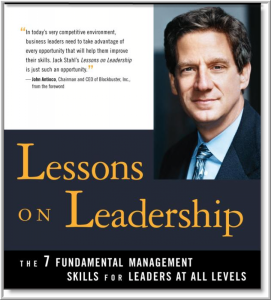
[Review] Lessons on Leadership

I picked up Jack Stahl's "Lessons on Leadership" a while back, and was curious about whether it held anything for me. Why? In spite of the old axiom to "never judge a book by its cover," I got a little judgemental on this one. After all, Jack used to be CEO of Coca Cola and Revlon, so he must have big, bureaucratic ideas about how to be a leader, right? My procrastination genes kicked in for a while.

A few weeks later, I tossed this book into my bag, boarded a plane, and started reading it. I must admit - I misjudged this book, for sure. In fact, I think Stahl's experience in bigger, stodgier companies actually pushed him to go back to first principles, and figure out the basic skills and techniques required to lead in any size environment.

In this book, Stahl presents 7 "Frameworks" to provide perspective and guidance on dealing with 7 key aspects of a business. The Frameworks are:

  1. Leadership and Management
  2. Creating a High-Capability Organization
  3. Developing People
  4. Brand Positioning with Consumers
  5. Customer Relationship Management
  6. Financial Strategy Management
  7. Influencing People

Some of these, such as Branding, bring out areas that are often overlooked by people in smaller companies. After all, weaving key principles of branding into your plans when you're small can really pay off if your company grows.

In each and every one of these sections, I found nuggets of wisdom I could apply to my current company, and ideas that could have helped me in a number of past situations. Part of the power of the book is that Stahl illustrates many of his points with real world situations - both good and bad. A small example of leading from the front / walking the talk:

"At Coca-Cola, a critical part of growing the company's business was outstanding in-store execution -- getting product to the store in a timely fashion, getting retailer shelves stocked properly with Coca-Cola products, seeing that the products were "faced," or pointed, in the right direction so the consumer could easily identify our brands, and pulling bottles of Coca-Cola and other products forward on the shelves to be within easy reach of the consumer.

"A senior leader of a large Coca-Cola bottler was relentless in this task. He traveled constantly to retail stores, focusing on quality execution by observing attention to detail. His energy sent a clear message to his operating managers on both sides of the Atlantic that attention to execution of details was a critical driver of success. He sent that message out clearly every day by example, through his own constant attention to execution at the point of sale. This focus helped accelerate growth and increased market share. Focus your own energy on the details of your business to drive results."

The book is full of object lessons from Stahl's experiences, most of which apply to large and small businesses. For example, consider the story above - if you're a sole proprietor:

  • What are the details that will make the most difference in your accessibility to your customers?
  • What details will set you apart from the competition?
  • What consistent, persistent things do you want to be "known for?"
  • And, what can you do - day in and day out - to create that bond with your customers?

Likewise, if you're an employer of others, what messages do your day-to-day actions send to your staff?

I enjoyed this book, and I think you will too. Scan the 7 Frameworks above and see if any of them need brushing up in your work. [And don't judge a book by its cover!]

Read More