Genuine Curiosity

Author Dwayne Melancon is always on the lookout for new things to learn. An ecclectic collection of postings on personal productivity, travel, good books, gadgets, leadership & management, and many other things.


Do you deserve your own aisle?

When you walk into a typical supermarket, you'll notice signs at the end of each aisle that give you an idea what's on the aisle. Obviously, it's not practical to include everything the aisle contains on these signs, so they narrow it down to the most popular or in-demand items.

In other words, these signs represent the most sought after categories of items in the supermarket. These tend to be the "staples of life" that are frequently listed on most people's grocery shopping lists. In fact, many of these items (such as bread, milk, eggs and, in my case, coffee) are important enough that you may go to the supermarket solely to get one of these important items.

Take inventory

With that in mind, think about your skills - the "things you're known for." How many of your best skills are important enough that people regularly seek you out to leverage those abilities?

If one of the skills you're good at is a "staple skill" you are lucky because you will probably be sought out frequently. For example, people may seek you out for your planning & organizing skills. You may even become the "go to" person for that skill in your organization - in essence, you'll have a place on the sign at the beginning of the aisle.

But if your best skills are very specialized, you may not show up on people's shopping lists very often - or they may not know you "sell" that particular skill. Consequently, they will walk past your aisle in the skills supermarket without ever realizing you were there.

Drive demand

To continue the supermarket analogy, there are a lots of ways to drive the kind of awareness that will result in people seeking you out. Here are some examples, along with some things to think about in each area:

  • Advertising / Promotion - How can you let people know (inside your organization or beyond) what you have to offer?
    • You can get the word out through blogging, advertising, contributed articles, and things like that.
    • Try to think about who would be a receptive "customer" audience for your skills and strategize about the best way to reach that audience.
    • Remember that the key to successful advertising is consistent impressions over time- be clear, concise, and persistent.
  • Word of mouth (satisfied customers)
    • This is perhaps the most powerful way to drive brand awareness. People look to others' experiences and recommendations when making decisions and trying to solve a problem. Your goal is to get people to recommend you when someone they know is looking for something you're good at.
    • The problem is that you can't get word of mouth until people have experienced the value you provide - which brings us to...
  • Free samples
    • If you're just getting started in promoting your personal brand, you might consider offering your services to others for no cost - in exchange for a testimonial, recommendation, or referral. If you create a few enthusiastic, satisfied customers who will provide a reference for you, all the rest of your brand building will get easier.

OK, so I might be stretching the metaphor just a bit with this post, but my point is this:

You may have tons of value to offer to others, but if people don't know about your abilities or don't know where to find you, your contributions will be limited.

It's up to you to get the word out and drive demand for your skills. Keep at it, and you just may end up with your own sign at the end of the aisle.


Picture credit: "Tea, only barely" by Yusuke Toyoda

[Review] The Myth of Multitasking

About 20 years ago, I read my first "management fable" style of book. It was the classic Ken Blanchard book, "The One Minute Manager." I wasn't 'wowed' by the book, but I really liked the fable-style presentation. Since then, I've really enjoyed the fable style of business books, and quite a few management fables have made a lasting impression on me (you can see some of them in the "Related items" listing at the end of this review)."Remember this rule: the more responsibility you have, the more hats you wear, the more likely you are to become inefficient."

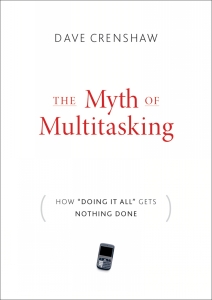
I'm happy to say that I've just read another book that's going to be a lasting part of my memory: it's Dave Crenshaw's, "The Myth of Multitasking (How 'Doing It All' Gets Nothing Done)".

You're fooling yourself

The core principle of this book really resonated with me: you're fooling yourself when you try to "multitask" activities that require your focus and attention, as this approach introduces inefficiencies that cost you more (both in terms of time and quality) than you realize.

Crenshaw presents a tale of Helen Whitman, a chaotic, frustrated business leader who is working very hard but getting burned out because her business's results are flatlining. Helen's frenetic work style has rubbed off on the rest of the business, creating lots of activity but yielding very little in terms of results.

The coach quickly determines that Helen's problem is her work style (which she thinks of as multitasking) is preventing her from giving adequate attention to important tasks, her family, and her team. The coach explains that multitasking is a myth -- a 'damned lie' to be precise -- and she isn't doing multiple things at once. What she is actually doing is rapidly shifting from one task to another. In the book, this approach is called "switchtasking," and there is a great exercise in the book to show the inefficiency of switchtasking.

What about the times when you feel you can successfully do two things at once? The coach makes a distinction between switchtasking and "background tasking" such as driving while talking on the phone, but he asserts that even with background tasking there is a cost.


What's it costing you?

Using some simple but illuminating exercises, the coach illustrates just how inefficient switchtasking really is and then takes Helen through a process to illustrate just how much this inefficiency is costing in terms of productivity. Through these activities, Helen realizes her sense of time is very distorted and she also becomes painfully aware that her efforts to give people and multiple tasks her attention all at once is creating some extreme dysfunction in her relationships with her family and employees.

Worse, Helen realizes that her bad habits are rubbing off on her team, and trickling down to impact their relationships with customers. Not good. But, as the saying goes, the first step is to admit you have a problem and ask for help -- and Helen does just that.

The rest of the book takes us through the changes (small and large) that Helen makes in her working style which help her defend her time, and strengthen others' trust in her by demonstrating that she is worthy of their trust.

Don't worry - you, too, can have a happy ending

OK, you're probably not surprised that the book has a happy ending, but you may be pleasantly surprised at some of the practical methods it includes to help you gain control of your time, improve your results and achieve a better quality of life.

To augment the story, Crenshaw includes a meaty set of worksheets and exercises in the appendix to help you replicate the same kind of personal discovery and analysis that Helen goes through in the book. It's up to you to apply what you learn, but I found it very helpful to have the tools at hand along with the instructions for how to use them.

This book is a quick and easy read -- the fable portion is about 100 pages long -- but it packs a lot of learning in a short space. I recommend it for anyone who wants to be more productive, but I particularly recommend it for anyone who believes they are a good multitasker. Is that you? If so - remember, it's not called "The Myth of Multitasking" for nothing...


Related items


Verizon FiOS high speed internet - here is why I like it

The results in the image below show the speed of FiOS over my WiFi connection, tested using http://www.speakeasy.net/speedtest. I haven't tested it on my direct connected computer (i.e. non-wireless) yet, but even over wireless this is quite a bit faster than Comcast ever was for me, in spite of Comcast's aggressive claims.

To make it even sweeter, for my bundle of phone, internet, and television all together I pay Verizon $30 per month less than I used to pay Comcast for just internet and television. Oh - and I have more premium channels on Verizon.

If Verizon is putting fiberoptic cable in your neighborhood, I strongly recommend that you make the switch to FiOS.

Read More

Amazon Prime is awesome

I mention Amazon Prime in my posts from time to time, and was a very early member of this special program from Amazon. I got a question about it this week: "So just what is Amazon Prime, and why do you like it so much?"


Free Two-Day shipping (and cheap Overnight shipping when you really need it)


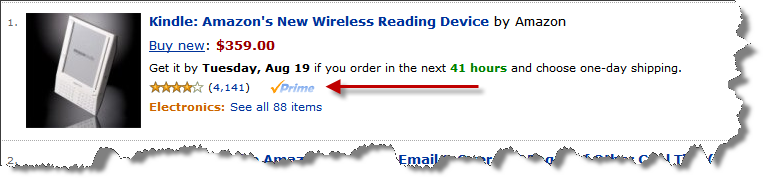
Amazon Prime is a program that allows you to pay an annual membership fee to get unlimited free Two-Day Shipping on millions of eligible items. It's easy to tell which items are elegible by looking for the recognizable "Prime" logo, which you can see in the search results example here which I just grabbed as I watch the Olympics this fine Saturday evening:


I order things this way all the time, and you don't have to worry about the normal rules of "Super Saver Shipping" - you get things in 2 business days automatically. When I'm in a particular hurry (sometimes I need to get things asap so I can receive them before a trip, for example) I can pay an extra $3.99 to upgrade to Overnight Shipping - that is way cool.

By the way - with the high price of gas, I have found myself buying more things through Amazon Prime than ever - it saves driving all over the place looking for what I want. And I know I'll get what I ordered a couple of days, which is usually fast enough.

Pass it around

There are a couple of ways you can share this special shipping benefit with other people:

  1. Anything "Prime" item qualifies - whether you ship it to yourself or someone else. I have used this to great benefit during the last two Christmas seasons. It gives me quite a few extra shopping days with no extra fees for expedited shipping.
  2. You can share your benefits with up to 4 other people living in your household.

It's a great value - and you can try it for free

Amazon Prime costs $79 per year (averaging to a bit more than 6 bucks a month), and I know it saves me much more than that every year. Not sure if it's for you? Give it a try - they'll let you take a test drive for 30 days - just click here if you want to take an Amazon Prime free trial.

[Review] Big Ideas to Big Results

Many organizations reach a point in their existence when they hit a plateau or begin to stagnate. When that happens, they often seek a "breakthrough" in their performance. Sometimes, they succeed and sometimes they don't.

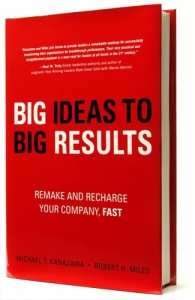
I recently read "Big Ideas to Big Results," by Michael Kanazawa and Robert Miles, which is all about increasing your chance of success when you're seeking to re-vitalize your company. This book had a unique attraction for me, since I worked with Mike and Bob on one of the transformations they discuss in the book (it was called "Taking Charge" and is referred to at various points throughout the book, but specifically summarized on page 118 & 119).

The authors have worked together on a number of corporate transformations, and they share their experiences to help us minimize the chances that we'll run the "typical" course: some lame, corporate feelgood program that achieves nothing. I've been there and it is not a fun fate.

Beware of zombies

The authors do a nice job of keeping things interesting by telling colorful stories to illustrate their points. One I enjoyed is Michael Kanazawa's discussion of "Zombie Projects" which he encountered, ironically, while working in the same area as Dilbert's creator Scott Adams.

"Zombie projects had supposedly been killed through inattention or lack of formal funding, but, in fact, they continued to live on as pet projects of key manager who couldn't or wouldn't let go."

These kinds of projects suck resources and motivation from the rest of the organization, causing "drag" on the business. The authors discuss the reasons these projects are allowed to exist and most of the book deals with how to ferret out and get rid of these kinds of useless activities.

Set the right drumbeat

Another interesting topic covered in the book deals with how leaders can make or break their team's success through the "drumbeat" they establish. Examples of leaders who to force too much "sense of urgency," which often has the opposite effect; rather than getting people to work harder or faster, their "urgency" shuts down debate and makes people feel anxious or frustrated.

They offer some powerful tips for how to manage your team's "sense of time" so that people use their times productively, without panic, and without feeling like they'll slow down progress by injecting their opinions or challenging things that are happening.

Engage the masses

One of the things that comes out strongly in the book (and one of the most memorable aspects of the Taking Charge project I was part of) is that the authors have developed a true methodology for engaging  people across a company and focusing them on a specific set of outcomes. Their construct called "Tablework" is a big part of encouraging innovative thinking and microcollaboration among small teams, which is then reconnected back into the company's larger objectives.

Perhaps the most powerful aspect of their approach is the drive to create "leaders at all levels" - crucial in creating a self-sustaining, effective business that can scale. A big part of that is letting people throughout the organization own various aspects of strategy and execution - and holding them accountable.

But one other vital aspect of this is making sure people feel recognized for their part in the company's success, and helping them discern the difference between things they must do and things they must strive for. They present the latter using a concept I really love - the distinction between "promises" (absolute goals) and "declarations" (a statement of intent when the means to get there are unknown).

Get big

This book is jam packed with information and techniques, but is fun to read. I also believe it can be a handy recipe book to help managers and leaders deal with specific problem areas, even if you don't go through the whole transformation process form end-to-end.

If you're a leader looking to drive your business out of the "same old same old" then I highly recommend Big Ideas to Big Results.


Related items

Read More