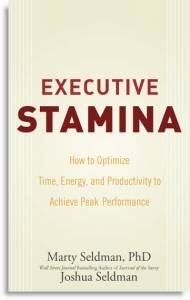
 In another example of a book that comes into my life at an opportune time, I have been reading a book designed to help you systematically achieve higher productivity and better "balance" in life. The book is "Executive Stamina: How to Optimize Time, Energy, and Productivity to Achieve Peak Performance," by Marty Seldman, PhD and Joshua Seldman and I am hooked.
This book is similar to another book I've read and liked (but never reviewed) called "Find Your Focus Zone." However, I find Executive Stamina to be more "prescriptive" -- and its focus and style resonated better with me.
One of the authors of Executive Stamina is a clinical psychologist who's done corporate coaching, and the other is a respected cycling and fitness coach. They combine their respective disciplines in an interesting way, producing a guide that is designed to help people manage the natural peaks and valleys of mental and physical energy.
Stop the Thrash
This book is more than just an energy management guide - it also presents some very powerful exercises to help you improve the results you get in life.
 Essentially, Executive Stamina seeks to keep you from "topping out" in your career - reaching that point where you hit a performance / interest plateau from which you cannot recover. As shown in the diagram at right, from the book's introduction, the key is to avoid reaching the point of diminishing returns in your work - avoiding what I like to refer to as "thrash."
The book is divided into 5 major sections, each focusing on models and assignments to deal with a specific aspect of your life - resulting in a combined set of skills to keep you out of the Danger Zone shown on the chart. Here is a brief rundown of what you can expect in each section:
- Work / Life Alignment
- This section focuses on introspection and answering hard questions about your priorities, values, etc. with the goal of helping you reach your career sweet spot.
- This was by far the most difficult section for me, since it prompted me to revisit past situations in which my choices probably weren't well-aligned with my values. For the same reason, this was also one of the more impactful sections of the book.
- My favorite tool in this section was the "Minimums and Shifts/Drifts" model, which is a tremendous focusing tool to drive specific action towards goals, and identify shortfalls quickly while you can still do something about them.
- Building Your Stamina
- This is a very prescriptive section, primarily dealing with stress management, exercise, nutrition, and other aspects of physical health & stamina.
- I had a lot of favorite tools in this section:
- the Lifelong Fitness Plan
- the instructions on Meditation and Breathing Exercises
- the comprehensive guide for "Workday Yoga" which includes yoga exercises designed to be performed at work.
- Optimizing Job Performance and Results
- This section focuses on getting better at finding and focusing on high-payoff activities - increasing your win rate, and raising the value of your output.
- The tools in this section are very simple, and very much aligned with many of the productivity/time management frameworks I know and love. I particularly liked the portions on "Dealing with Toxic People" and the tips and techniques for overcoming procrastination.
- Career Management
- In this section, the authors focus on the fact that there is a big difference between high productivity and reaching your peak potential. With that in mind, they arm you to tell the difference between the two.
- This section is still about personal elements of your performance, and provides a lot of guidance on preventing career mis-steps. However, it goes further and pulls in tools to help you look outward to figure out when other people are discounting your achievements, so you can prevent them from hampering your progress.
- My favorite tool in this section is the one on Organizational Savvy, which includes the "Org Savvy Chart" to assess your strengths and weaknesses in this area.
- Personal Relationships
- The final section of the book emphasizes that personal relationships are a thread that winds through all of the previous chapters - personal relationships play a significant factor in reaching your peak potential.
- Interestingly, this section describes how you can apply the tools from previous sections to systematically set goals and improve your relationships by focusing on high-payoff aspects of those relationships. Very cool.
Hopefully this gives you a taste for this book. It's smart, actionable, and well written, and I think it is a must-have for any executive (or anyone who aspires to be "master of their destiny").
Related items
- Book Review: Mastery (5/5/2005)
- A Quest for Genius (12/11/2005)
- [Review] Flippen's sweet book (7/10/2007)
- [Review] Ignited! (6/12/2007)

 Be rational: Think before you act.
 On a flight this morning, I was chatting with a gentleman sitting next to me. He shared a recent learning (he called it a "guidepost") he adopted recently. I thought it was interesting: