Genuine Curiosity

Author Dwayne Melancon is always on the lookout for new things to learn. An ecclectic collection of postings on personal productivity, travel, good books, gadgets, leadership & management, and many other things.


Updated: Free presentation creation seminar

[Note: This post previously announced this seminar - now it tells you how to access the archive]

This morning, I saw an online seminar by Cliff Atkinson (author of Beyond Bullet Points) called: Creating a 15-Minute Presentation in 1-Hour. It is a very useful walk-through of the process from start-to-finish, and illustrates the concepts from Cliff's book very effectively.

You can access the content by clicking the link above (may require a free registration at Microsoft Office Online).

Take advantage of this Freebie if you have any interest in improving your presentation creation skillz.

Cliff's seminars never disappoint - I'm a member of his Beyond Bullet Points (BBP) community, and it is worth the price of admission - he does weekly e-Lessons on various topics, including soliciting topics from volunteers in the BBP community. He actually creates presentations with the volunteers, based on their topic - cool stuff.


Related items

Read More

Improve your productivity: Establish your operating principles

Last week, I posted about some excellent analysis by Tim Ferriss ("You wouldn't like me when I'm unproductive...") comparing the "fighting styles" of various productivity gurus. If you aren't familiar with Tim's work, he is the author of "The 4 Hour Work Week," which is chock full of ideas to change you life. It certainly changed my mental models in a significant way.

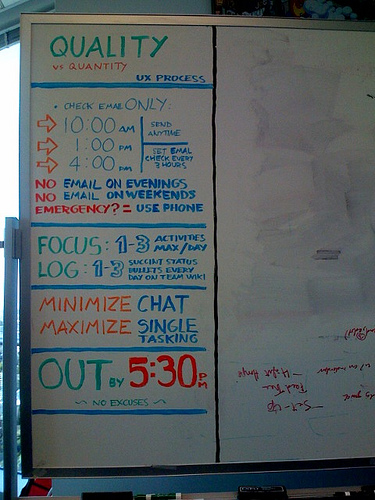
Anyway, browsing around Tim's blog, I stumbled across his Flickr photostream where I saw the photo at right. It depicts a set of operating guidelines he developed while working with a department in a Fortune 500 company.

I really like this concept, and my colleague Matt and I are just beginning to experiment with our own variations of this approach. If you break down what's on the board, it has an excellent set of guidance embedded in it:

  • Throttle back on email. Don't check it constantly, and don't do work email away from work.
  • Focus on a few specific, high value activities per day.
  • Record your results - and if you're on a team, let the team know what you're doing (I love that they are using a Wiki for that).
  • Minimize unproductive chatting.
  • Focus on one thing at a time and avoid the overhead of multitasking. (My buddy Gene and I use the analogy that even though an air traffic controller has lots of planes queuing up, each one should only land one plane at a time.)
  • Get out on time. I think this has a good psychological effect for driving better focus, and helps prevent tasks from expanding to consume all the available time.

I'll keep you posted on how it goes with our experiment. I don't know if I can go quite as "purist" as what's on this board. For example, given how my work is structured, it's unlikely that I'll totally eliminate all after-hours email in the near future, but I can certainly do less of it.

Even so, I definitely think establishing some operating guidelines like these will help me and the others on my team.

Read More

"You wouldn't like me when I'm unproductive..."

I read an awesome post by Tim Ferriss (author of The 4-Hour Workweek), on Time Management Guru-itis: Mark Hurst vs. David Allen and Tim Ferriss. It's quite an interesting analysis, and I think it is pretty accurate and insightful.

One of the interesting differences in Tim's dealio is that it's very much about how you feel as you live your life - not just how productive you are. As Tim puts it:

"Is responding to all inquiries on a moment's notice really success? I would argue it is a reactive mode that precludes life, at least the type of life I want to have."

I must admit, this is one of the things I often struggle with. Getting my balance slider bar set to the right setting is tricky. Why? Well, the optimum setting for balance can vary depending on the demands (or lack thereof) stemming from work, personal life, etc. There is the flip side, as well, in which you "impose" a balance setting on your life, then make your activities fit that setting.

Ferriss and David Allen (of GTD fame) both offer methods to impose your own balance setting, but they have completely different approaches for how to get there. I've learned tips, techniques, and philosophies from both of them, and I think they have both impacted my thinking far more than I ever expected.

Check out Tim's analysis and join the conversation (and thanks to Matt for pointing the article out today).

Read More

Control for team projects

I've been test driving a web-based project management tool called Projjex, and it is pretty cool. I'm using the free version, which is limited to a single project (but supports multiple users/participants for that project). Even with the single-project limitation, the free version of Projjex does a nice job of showing off the UI and features of the tool.

The user experience is very straight forward, and I can see myself using this to track progress on more complex personal projects, as well as using this for group collaboration.

Easy setup

Projjex makes it easy to set up a new project, add users, and begin adding and assigning tasks. If you want to migrate from an existing project management tool, they offer easy imports from Microsoft Project, Basecamp, or a CSV (comma-separated value) file.

The most common functions are easily accessible from within a project, via a straight-forward Edit menu (at right).

There are also so very good video tutorials in the product so it's a snap to get going.

Easy management

Projjex provides a clean dashboard to monitor the "next action" or "next in line" tasks and their owners (click the image below for a larger view - you may have to click it again in the window that pops up to get it to fully zoom).

The dashboard makes it very easy for a project manager to use for tracking and bugging people with due or overdue tasks.
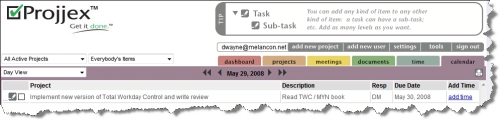
There is also a good interface for scheduling and timing meetings, including distributing attachments along with the meeting invitation. However, I wish it had a bit more functionality to record meeting notes and associate them directly with meetings, as well as providing built-in functions to track open and resolved items, meeting objectives, etc. Perhaps in future versions... (though you can probably work around this with their powerful, collaborative Notes features).

Room to grow

For more projects and additional features (like time & cost tracking, and more disk storage for storing and sharing documents), you can upgrade to a higher level package. There are 4 fee-based subscriptions available (Team, Professional, Corporate, and Enterprise), each with a progressively higher monthly fee so you can scale up as you begin to use Projjex for more projects.

Check it out for free

As with many other web-based apps, this one is easy to try for free. Head on over to Projjex and sign up for your free account, or at least go through the Projjex overview tour if you have projects to manage. And you might want to keep an eye on these folks - they seem like they know what they're about.


Related items Read More

The Parking Lot Rules

I've just finished reading a book I wish I'd had when my first child was born. It's Tom Sturges' book, Parking Lot Rules & 75 Other Ideas for Raising Amazing Children. This book is a set of pragmatic "rules" to help provide a safe, nurturing environment for kids as they grow up. Some of these techniques would have saved me some stress if I'd known about them 15 years ago when I first became a father!

To get a flavor for the excellent advice in this book, check out the rule the book was named for, Parking Lot Rules:

"In a world inhabited by cars the size of small houses, the parking lot can be an incredibly dangerous place. The drivers of these SUV's are in another world: watching their own children, talking on their cell phones, listening to the radio. The last they they are looking for is your brood. Teach your children that they need to be right next to you whenever you are in a parking lot. There is to be no trailing behind and no racing ahead. The moment you near a parking lot, call out "Parking lot rules," and your children will know that they absolutely must be by your side. This rule can also apply to any time you perceive a danger that your children have missed: perhaps raised voices or the sound of broken glass or a stranger acting erratically. It beats yelling, "Look out for the crazy guy!"

And this is only one example - just about every rule hit the mark for me, and they're very practical (I love the Bon Jovi Rule, the Truth Reduces Punishment by 90% rule, and The Power of Forgiveness).

This book is ideal for parents of young children, but most of the rules still apply for older kids and teens. I think Parking Lot Rules will become one of my default gifts for new dads. It's a beautiful collection of advice.

Read More