Genuine Curiosity

Author Dwayne Melancon is always on the lookout for new things to learn. An ecclectic collection of postings on personal productivity, travel, good books, gadgets, leadership & management, and many other things.


The Manager's Cheat Sheet: 101 Common Sense Rules for Leaders

Management is all about connecting with the people on your team. So how do you effectively manage a team? With common knowledge of people, of course. These are a few back-to-basics rules that will help you develop essential management skills. This list is an excellent resource for any leader.

A couple that resonate particularly well for me:

36. Improve your skills. Learning is a lifelong process. You're never too old to take a class or ask a co-worker to help you improve your knowledge.
45. Focus your energy on things that matter. Don't let trivial tasks take time away from things that are really important.

Go check out the rest of the list! read more

Read More

Great perspective in forty bite-sized servings

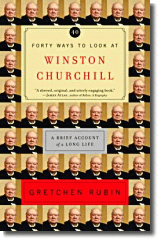
I recently had the pleasure of reading Gretchen Rubin's book, "Forty Ways to Look at Winston Churchill: A Brief Account of a Long Life." This book offers a fascinating, intriguing way to present biographical information about Churchill.

Each of Gretchen's forty chapters takes a different aspect of Churchill's life and legacy, and presents it from a distinct perspective. In some chapters, the information is presented as a skeptical or critical observer might present it. In others, the information is presented through the lense of an admiring fan. And, in others, in an objective, "Just the facts, ma'am" kind of way.

The result is wonderful.

I didn't know a great deal about Churchill before I read this book though I felt a sense of respect for him from all of the historical accounts I've read about World War II. After reading this book,

  • I now know a great deal about his formative years (childhood and early adulthood) which I found to be both sad and inspiring.
  • I learned that he could quickly transition from boorish to inspiring -- and sometimes both impressions could be achieved by the same speech, depending on the listener's bias.
  • I discovered that Churchill himself was a prolific author and Pulitzer prize winner.
  • I learned that he was adept at creating feelings and changing perceptions (even recasting past events to reshape them into idealistic accounts).
  • And I learned about many scandals, spectacular failures & embarrassments, and the world-changing triumphs in this great man's life.

And these simple bullet points don't do any of these things justice. But the book does. I recommend this book to anyone who's looking for a creative, enjoyable reading journey about the fascinating historical figure of Winston Churchill.

Read More

Buy remarkable book, get remarkable deal, become remarkable leader

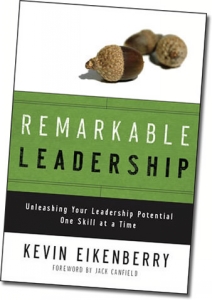
Ok, so I haven't read this book yet, but I can't resist passing on an awesome deal: when you buy Kevin Eikenberry's new book, Remarkable Leadership, you get a fantastic bunch of bonuses that make it worth its weight in gold.   To order, click one of the links above, scroll down to see the bonuses, and look for the ordering links near the end of the page - you need to order through one of those links get the bonuses.

In addition to the free stuff, there are a couple of other reasons I'm recommending this before I read it:

  1. I've been following Kevin's blog for quite a while, and I think he has some awesome leadership kung fu
  2. Kevin's trying to concentrate the buying of this book right away so he can become an Amazon best seller

On a related note, Kevin and his team also offer the Remarkable Leadership Learning System, which is a powerful program to help you become a better leader by guiding you through focused work on a specific topic each month. Check it out if you're looking for a leadership breakthrough.

By the way - I will be reviewing this book in the future - after I get my own copy!


Related items:

Read More

[Review] Leadership Secrets of the Rogue Warrior

One of my mentors (Barry Rhein, the guy who gave me the words to name my "genuine curiosity") recently gave me Richard Marcinko's book, "Leadership Secrets of the Rogue Warrior." This is not a new book, and I'm surprised I haven't run across it before. But man - I am very glad I know about it now.

Marcinko's "in your face" writing style initially led me to believe this was about the most irreverent management book I'd ever read. As I got into it, I realized I'd missed the point. Marcinko is actually very respectful - to those who've earned his respect, regardless of their rank, position, etc. And, in stark contrast, he is absolutely (scathingly) irreverent toward anyone who refuses to learn how to be a better leader, or chooses to be comfortable in a life of incompetence.

The Ten Commandments of the Rogue Warrior

This book takes you through a comprehensive set of management principals by introducing you to each of the "Ten Commandments of the Rogue Warrior." Each "commandment" is explored in Marcinko's colorful way, then illustrated with vivid, memorable true-life stories that really drive the point home. Some of the stories are Marcinko's own, while others draw on great leaders of history (not just military leaders, by the way) to explain how they dealt with difficult situations in a manner consistent with the ten commandments.

I won't go through them all in this review, but here are a couple of the commandments to give you a feel for what they're like - I picked these because I learned significant new things from them:

4. I shall punish thy bodies because the more thou sweatest in training, the less thou bleedest in combat.

This one is about being prepared, but goes beyond "thinking" about being prepared. Marcinko urges businesses to conduct "war game" like exercises (red team vs. blue team) to vigorously test out strategies, and come to view your own company as your competition sees you. Very powerful.

8. Thou shalt never assume.

Excellent illustrations here about the fatal potential of relying on conventional wisdom, flawed first impressions, and thinking you know what others expectations are without confirming them.

The stories in these chapters make these commandments come alive.

The Rogue Warrior's Leadership Code

The "ten commandments" are all derived from The Rogue Warrior's Leadership Code, which has been defined, refined and exemplified by Marcinko throughout his career. The principles are:

  • I will test my theories on myself first. I will be my own guinea pig.
  • I will be totally committed to what I believe, and I will risk all that I have for these beliefs.
  • I will back my subordinates all the way when they take reasonable risks to help me achieve my goals.
  • I will not punish my people for making mistakes. I will only punish them for not learning from their mistakes.
  • I will not be afraid to take action, because I know that almost any action is better than inaction. And I know that sometimes not acting is the boldest action of all.
  • I will always make it crystal clear where I stand and what I believe.
  • I will always be easy to find; I will be at the center of the battle.

--Richard Marcinko, "Leadership Secrets of the Rogue Warrior"

Marcinko's point is this: Whether you lead in life-or-death situations, or you lead in a "normal" corporate environment doesn't matter much - you need to aspire to great principles to be a great leader. What a powerful way to lead - and live.

The bottom line: This book is a wonderful combination of inspiration, instruction, admonishment, and motivation. I highly recommend it.

One word of warning: the language in this book is rough - it's peppered with "f-ing and blanking" - but the message, concepts, and stories are golden.


Related items:

Read More

[Review] The Art of Managing

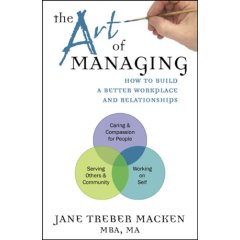
I've just read Jane Treber Macken's, "The Art of Managing: How to Build a Better Workplace and Relationships," and I quite enjoyed it. The beginning of the book felt a bit academic, sharing a lot about the history of management theory, and an overview of various management models and techniques used in the last 150 or so years. But don't let the clinical introduction turn you away - once the book gets going, the author adds a lot of interesting tools and engaging examples that make this a very good read.

The book is short - only about 100 pages - but it covers a lot of ground in a very effective fashion. Macken does a wonderful job of weaving in material from noted management experts, along with her own personal stories of life and management. She also presents some useful tools and mental models to help you become a more effective manager.

Managing by sitcom

A lot of the fun in this book comes from the way Macken livens things up with things you don't always seen in management books. For example, one model I liked exploring describes office relationship styles in terms of characters from the "I Love Lucy" and "Leave It To Beaver" television shows. I'm a cross between "Ethel" and "Ward," trying to become more consistently "Ward."

I was a huge fan of these shows, so it was a fun exercise for me (and, even if you know nothing about those television shows, Macken describes how to use the model to apply it within your own context).

A plethora of tools

Other models and tools she discusses with her own spin include the Myers-Briggs Type Indicator model, group development and conflict resolution techniques, motivational techniques, and a model for situational leadership.

Finally, she rounds it out with a great set of tools to assess the effectiveness and alignment of an organization, and discusses methods to address any weaknesses or mis-alignment you may discover.

In summary, I liked this book because it gave me some new twists on some familiar management models, as well as teaching me some new tools and techniques I can apply to become a better manager. I believe it would be equally useful to new managers and seasoned veterans.

Read More